CoinGabbar: How Concordium is Bridging Web3 & Real World Finance
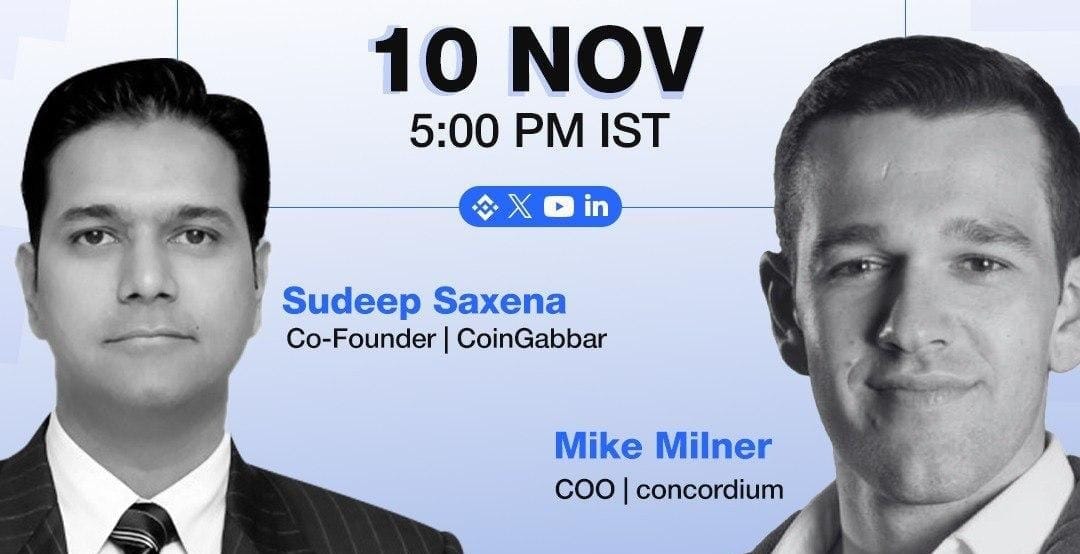
On November 10, Concordium’s Chief Product Officer Mike Milner joined CoinGabbar for a wide-ranging session exploring the blockchain’s identity-first architecture, institutional potential, and roadmap for stablecoin rails and regulated DeFi.
The session touched on everything from Web3 compliance challenges to zero-knowledge proof applications, and offered rare clarity on how Concordium sees its role in enabling real-world crypto adoption through privacy-preserving compliance.
Below is a structured summary of the key takeaways from the discussion, capturing the core insights in concise bullet form.
1 Opening Remarks – Setting the Stage
- Host: Sudeep (Coin Gabbar)
- Guest: Mike Milner, Chief Commercial Officer, Concordium
- Brief introduction to Concordium as “a different kind of project” in the blockchain space.
- Concordium’s tagline: “Smart Money starts here.”
- Overview of Concordium’s concept and purpose before moving into market discussion.
- Comments:
2. Market Sentiment and Institutional Presence
- No directional market prediction.
- Eight years in the industry; same recurring narrative at events and podcasts.
- For years: *“The institutions are coming.”*
- Now: institutions have arrived.
- ETFs are live.
- Regulation emerging globally.
- Market is in a "holding pattern".
- Waiting to see what happens next.
- Unclear who the winners and losers will be.
- Comments:
3. Regulation, Stability, and Institutional Entry
- Regulation seen as a stabilizing force in the market.
- Policy changes act as a green light for institutions.
- Financial institutions have been monitoring and gathering intel for years.
- Regulatory clarity gives them permission to enter.
- Market now in a wait-and-see phase:
- Which institutions will deliver what?
- Who wins at the corporate, blockchain, or asset level?
- Both expected elements are now present:
- Institutional entry and
- Regulatory frameworks
- Current moment is defined by anticipation: watching how the structure plays out.
- Comments:
4. Mike’s Journey into Crypto
- Entered crypto in late 2017 while working on the FX desk at a boutique brokerage in Mayfair, London.
- Rising client demand for Bitcoin led to the launch of GlobalBlock, one of London’s first crypto phone-broking desks.
- Started as 2–3% of activity; quickly grew to 80–90% of daily trades.
- Joined Copper in its early days (2019), when it was still a small team in Shoreditch.
- Copper focused on custody and collateral management, solving for single point of failure in bearer assets.
- Client base at Copper:
- ~75–80% hedge funds
- ~10–15% prop trading firms
- Remaining: ETP providers, exchanges, brokers
- Moved to Concordium about a year ago.
- Concordium had been a Copper client.
- Joined based on long-standing belief in the tech and its potential.
- Comments
5. Genesis of Concordium
- Concordium has existed for several years; not a recent launch.
- Recent changes involved new management and a shift in market focus.
- Founded by Lars Seier Christensen, co-founder and former CEO of Saxo Bank.
- Core belief: mass blockchain adoption requires accountability, not full anonymity.
- Vision: combine privacy with regulatory compliance by embedding identity at the protocol level.
- Every active wallet undergoes an ID check prior to use.
- Maintains anonymity on-chain for observers
- Ensures identity verification has occurred off-chain beforehand
- Comments
6. Beyond Blockchain Hype – Core Features and Differentiation
- Concordium’s base layer de-risks blockchain adoption.
- Solves for regulatory compliance, and anonymity concerns via built-in ID layer.
- Addresses cyber risk by removing dependence on smart contracts.
- Programmable money is native at the base layer.
- Conditional payments possible without exposing funds to smart contract risk.
- Example: recurring $100/month payments without counterparty or contract risk.
- Supports trigger-based payments using external data:
- GPS events (e.g. trade finance or delivery confirmation)
- Price oracles (e.g. for margin calls or collateral settlement)
- Funds remain in user-controlled wallets rather than locked in contracts.
- Partnership with Spiko (tokenized money market fund):
- Enables conditional payments while earning yield until payout triggers.
- Combines time value of money with smart payment logic.
- ~10 stablecoin issuers joined in H1 to leverage these capabilities.
- Identity layer enables attribute-verifying payments:
- E.g. prove age via ZK proof before accessing or paying for restricted content.
- Identity is verified but payments remain private within regulatory bounds.
- Combined value proposition:
- Smart payments without smart contract exposure
- Privacy-preserving compliance through ID layer
- Comments
7. Counterparty Risk and Time Value of Money
- Time value of money only applies if the stablecoin is yield-bearing.
- Concordium does not enable yield for non-interest-bearing stablecoins.
- Chose to support tokenized money market funds as a regulated path to daily interest.
- Combining yield-bearing assets with programmable payments enables capital efficiency.
- Example: scheduling known payments (e.g. mortgage, gym, car)
- Earn risk-free yield until exact moment payment is triggered.
- Most people hold cash in low-yield accounts while waiting for outgoing payments.
- Concordium allows automated yield capture without manually shifting funds.
- All happens without smart contract risk.
- Argument: if the future relies entirely on smart contracts, it may not be safer than today.
- Comments
8. Future Products and Roadmap
- Regulatory tailwinds (e.g. UK’s Online Safety Act, EU and US equivalents) open adoption opportunities.
- Age verification for restricted content (e.g. adult, gambling, cannabis) solved via ID layer + ZK proofs.
- User can prove they are 18+ without disclosing identity.
- Merchant receives verified result + audit trail.
- Roadmap extends beyond age:
- Use verified address data to enable geo-fenced payments.
- Block incoming transfers from sanctioned jurisdictions.
- ZK proof confirms jurisdiction before payment is accepted.
- Longer-term: enrich the ID wallet with more KYC-type data:
- Proof of address, source of funds, etc.
- Strategic focus areas:
- Build towards KYC-grade wallets
- Prepare for AI-driven agent payments
- e.g. agent buys wine on behalf of verified 18+ human
- Emphasis on focus and discipline:
- One go-to-market use case at a time
- Follow moments of regulatory or societal opportunity
- Comments
9. KYC, AML, and Privacy Interplay
- Distinction between two approaches:
- Performing KYC on-chain
- Verifying that a wallet belongs to someone who has been KYC’d off-chain
- Concordium supports the second approach today:
- Example: Barclays has KYC’d a user
- Concordium wallet was also opened with a passport
- ZK proof can link the two without revealing identity
- Enables institutions to confirm wallet ownership without exposing sensitive data.
- Built-in ID checks are handled by third-party providers, not Concordium itself
- Results stored as encrypted hashes on-chain
- Modular architecture allows future KYC-as-a-service integrations
- Possibility to add proofs of address, source of funds, etc.
- Long-term trajectory: gradual move toward on-chain KYC, depending on adoption and regulation
- Comments
10. Closing Reflections
- Concordium positioned as part of a paradigm shift in crypto.
- From speculative projects to real-world problem-solving.
- From “bull or bear runs” to regulated, stable infrastructure.
- Technology should be used to solve problems, not just generate earnings.
- Projects like Concordium are seen as signs of a maturing industry.
- Session summary:
- Concordium builds on solid fundamentals and systems.
- Offers a new model for compliance and utility in blockchain.
- Comments: