Holger Fischer at Subquery X-Space
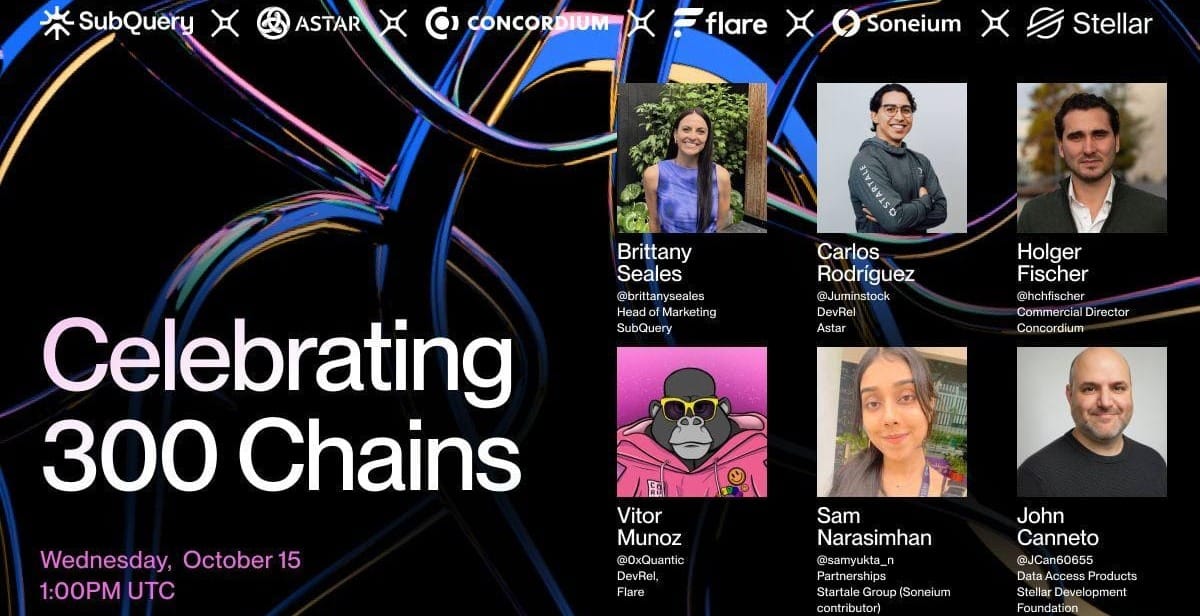
To mark its milestone of indexing 300 blockchains, SubQuery hosted a special X-Space featuring representatives from a handful of selected networks, including Stellar, Flare, Astar, and Concordium. While the event itself was not focused on Concordium, Holger Fischer was invited to represent the project and share Concordium’s positioning within the broader multi-chain and infrastructure landscape.
The following summary focuses exclusively on Holger’s contributions during the space. While this was not the most Concordium-centric format, Holger successfully reinforced key aspects of Concordium’s identity-first design, protocol-level stablecoin architecture, and builder-focused ecosystem, and did so in the company of some of the closest PayFi-adjacent competitors in the space.
1 What is Concordium?
- Identity-first Layer 1 focused on privacy and accountability
- Protocol-level digital ID with native commitments
- Zero-knowledge proofs allow selective disclosure (e.g. age, jurisdiction, KYB)
- Enables legal accountability without full doxing
- Designed for regulated payments infrastructure
- Privacy plus compliance — not privacy vs. compliance
- Supports use cases requiring disclosure under legal conditions
- New protocol version recently launched
- Includes 11 stablecoins
- Built for institutional use: predictable base layer, low fees, stable tooling
- Long-standing collaboration with SubQuery
- Mutual early belief in each other’s vision
- Infrastructure partners are key to Concordium’s strategy
2 What is Concordium’s view on multi-chain and interoperability?
- Multi-chain is real but still uneven
- Shift underway from pooled liquidity bridges to message-passing stacks
- Examples: LayerZero, Chainlink CCIP, Circle’s CCTP
- These reduce reliance on honeypots by avoiding large smart contract-held liquidity
- Honeypots seen as a “necessary evil” in past bridge models
- Liquidity trapped in vulnerable contracts led to repeated hacks
- Concordium addresses this with the PLT framework
- Stablecoins minted at the protocol level, not via smart contracts
- Removes honeypot risk entirely
- Sees growing maturity in cross-chain design
- Burn-and-mint and cross-chain calls becoming more standardized
- CCIP and others gaining traction with institutions (e.g. SWIFT pilots for 2025)
- Believes multi-chain is improving fast
- Still fragmented, but more user-centric models are emerging
- The race is on to break siloed networks — and one will come out on top
3 What does Concordium offer to developers and why does onboarding matter?
- Developer experience must start with clear docs and quick-starts
- Builders need familiar tooling for build, deploy, testing
- Example apps and startup templates are essential
- Uses industry-standard stacks for easy onboarding
- Includes support for zero-knowledge proofs and selective disclosure
- Wallet integrations: browser, mobile, WalletConnect
- Concordium wallets support
- Seed phrase recovery, multi-device access, guided setup
- Identity via approved providers; disclosure only under due process
- Live examples from current apps help new teams get started
- Low friction is critical for adoption
- Easier onboarding = faster time to market = more ecosystem value
- Feedback loops must be well structured
- Many chains lose feedback due to weak DevRel setups
- Strong DevRel is essential to keep ecosystems responsive and healthy
4 What advice does Concordium give to builders choosing a chain?
- Always study the chain’s value proposition and unique selling points
- Understand how your project aligns with the chain’s core strengths
- Avoid choosing ecosystems based on who offers the biggest grants
- Projects that prioritize funding over fit risk failure or short lifespans
- Real alignment increases survivability — especially in bear markets
- Chains are not one-size-fits-all
- Different networks serve different purposes — and that’s healthy
- This mistake has been widespread in the past, but is becoming less common
- Builders are learning to prioritize fit and long-term value creation
- Foundations and ecosystems respond much faster to teams who clearly “get” what the chain is built for