Powering Compliance-Ready PayFi with Concordium
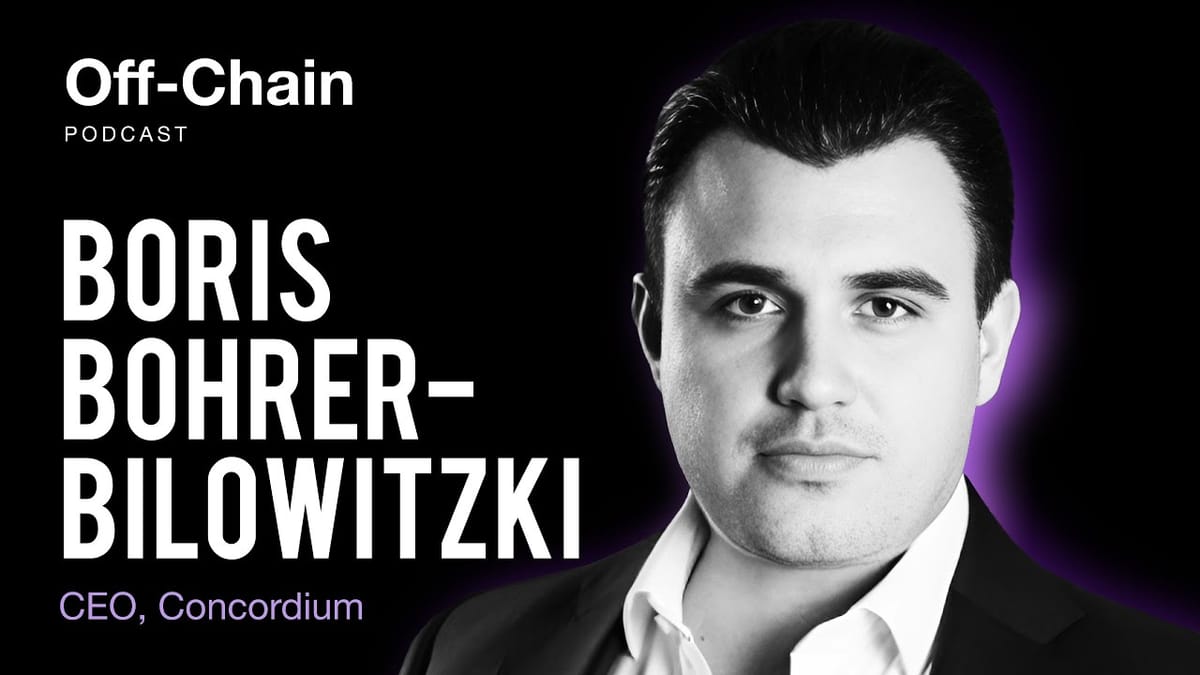
This conversation with Boris Bohrer-Bilowitzki in the Off-Chain podcast episode 79 stands out because it cuts through the usual crypto noise and goes straight to the structural issue: why blockchain, after all these years, still hasn’t meaningfully entered everyday life.
Instead of talking about TPS, DeFi loops, or speculative narratives, the discussion centers on something far more tangible, namely the uncomfortable reality that crypto has been optimized for insiders, while regulators, institutions, and normal users were never truly part of the design scope.
What the CEO of Concordium lays out is not a pitch for his chain, but a broader thesis about infrastructure: identity at the protocol level, compliance by design (rather than avoidance), and payment flows that recognize the time value of money as a first-class variable. In other words, the question is no longer how to make crypto larger, but how to make blockchain infrastructure compatible with the systems the real economy already runs on.
1. Context & Background
- Boris Bohrer-Bilowitzki is the CEO of Concordium and formerly a founding executive at Copper, one of the largest institutional crypto custody providers.
- His career spans traditional finance, brokerage, asset management, and institutional crypto infrastructure.
- A recurring personal distinction he makes is between:
- Operators (who scale and manage large systems)
- Builders (who create new infrastructure from first principles)
- He left Copper when it became large and corporate, seeking to return to building foundational systems that could enable real adoption rather than incremental optimization of existing rails.
2. Core Diagnosis: Why Crypto Adoption Failed
- Boris is explicit that crypto’s failure to reach mass adoption is not because it is “too early.”
- Key reasons he identifies:
- Crypto forced users to understand infrastructure instead of simply using it.
- Core UX failures:
- Seed phrases and irreversible loss
- Complex wallet mechanics
- Gas fees
- Fragmented onboarding
- The industry focused on:
- DeFi complexity
- Yield games
- Crypto-native speculation
- Meanwhile, ordinary users switched off immediately.
- Core principle:
- Blockchain must be used, not understood.
3. Concordium’s Foundational Thesis
- Concordium is designed around two core architectural decisions that Boris believes were missing from earlier blockchains.
3.1 Identity at the Protocol Level (Not the Application Layer)
- Concordium embeds identity directly into the base protocol.
- Users verify their identity once.
- All subsequent interactions rely on zero-knowledge proofs, not exposed personal data.
- What is proven
- Age
- Jurisdiction
- Compliance status
- What is not revealed:
- Name
- Address
- Passport copies
- Identity details on-chain
- Why this matters:
- Regulators care about compliance, not surveillance.
- Users care about privacy, not repeated KYC.
- Concordium is designed to satisfy both simultaneously.
- This architecture enables:
- Age-restricted services
- Regulated financial flows
- Travel-rule-compliant transactions
- Jurisdictional controls
- Privacy-preserving verification at scale
3.2 Smart Contracts Should Enforce Logic, Not Custody
- Boris is not anti–smart contract, but sharply critical of how they are used today.
- His distinction:
- Smart contracts are excellent for:
- Conditionality
- Automation
- Rules enforcement
- Smart contracts are poor custodians of funds, especially for institutions.
- Smart contracts are excellent for:
- Problems he highlights:
- Smart-contract custody creates honeypots.
- Nearly all major hacks occur at the contract layer, not the protocol layer.
- Institutional risk officers and compliance officers will not accept this model.
- Concordium’s alternative:
- Issuance and control at the protocol level
- Smart contracts used to enforce conditions, not hold value
- Reduced custody risk
- Greater institutional acceptability
4. Stablecoins: Why They Haven’t “Won” Yet
- Boris rejects the idea that stablecoins have achieved mainstream success.
- Current usage is largely limited to:
- Trading pairs
- Derivatives collateral
- DeFi loops
- Emerging-market workarounds
- What is missing:
- Integration into everyday economic flows
- Use in regulated environments
- Seamless compliance and usability
- Stablecoins only scale when:
- Compliance is native
- Identity is verifiable
- Payments can be programmed without custody risk
5. PayFi and the Time Value of Money
- One of the most distinctive parts of the conversation is Boris’ focus on time value of money.
- Key idea:
- Money locked for payments should not sit idle.
- Examples discussed:
- Rental deposits
- Trade finance
- Escrow-like arrangements
- Subscription or conditional payments
- With tokenized, yield-bearing assets:
- Funds can earn yield while locked
- Intermediaries (banks, payment processors) can be disintermediated
- Programmable payments become economically superior to card rails
6. High-Risk, Regulated Verticals as the First Adoption Wave
- Adult content
- Online gambling
- High-compliance digital services
- Why these verticals matter:
- They already face banking friction
- They require age and identity verification
- They adopt new technology faster than mainstream finance
- They generate massive transaction volumes
7. Tooling and UX: The Hidden Adoption Barrier
- Seed phrases are unacceptable for mainstream users.
- Fear of irreversible loss blocks adoption.
- Wallet UX must abstract complexity completely.
- Adoption will only happen when:
- Blockchain disappears behind familiar interfaces
- Identity acts as a password
- Users interact without knowing they are using blockchain
8. AI, Agents, and Programmable Payments
- AI agents making autonomous purchases
- Conditional, identity-verified payments
- Automated commerce with built-in compliance
- AI requires:
- Trusted identity
- Programmable, compliant payments
9. Distribution Strategy: Extend, Don’t Compete
- Provide identity and compliance layers
- Integrate with existing ecosystems
- Make other chains compliant via verifiable credentials
- Key partnerships mentioned:
- Ledger
- Bitcoin.com
10. Market Outlook and 2026 View
- The four-year cycle is not broken.
- Regulatory clarity will come incrementally.
- Many projects will fail, which is healthy.
- Speculation will give way to infrastructure solving real problems.
11. Final Takeaway
- Crypto failed because it optimized for insiders.
- Adoption requires compliance, privacy, usability, and economic logic.
- Concordium is built to operate where regulation exists.
- Payments, identity, and programmability must converge at the protocol level.
The ambition is not to replace finance overnight, but to make blockchain unavoidable by making it invisible.
12. End note
This reworked segment is a short extract. Full video breakdowns are available to subscribers of the free blog tier. Inner Circle members receive access to deeper, detailed analysis.