
TOWN HALL 4 - PART 3 TECHNICAL UPDATE
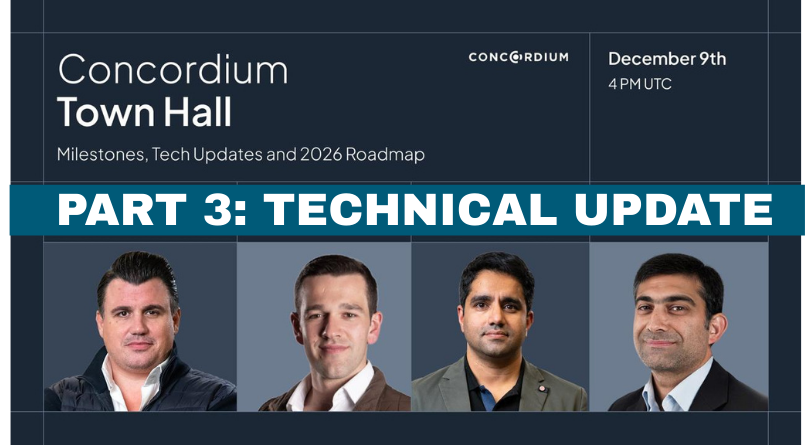
Part 3 of the Town Hall moves from commercial traction to the technical engine that made it possible. Here, CTO Peter Marirosan outlines what was delivered on the protocol and product side during 2025, a year defined by shipping core infrastructure, not experimental features. The focus was clear: extract Concordium’s built-in identity layer into usable products, eliminate smart-contract risk through Protocol-Level Tokens, and build a verification architecture capable of real-world scale and regulatory alignment.
The presentation shows how Concordium’s technical stack evolved from design principles into live systems:
- Identity operationalized through the ID App
- PLTs live as a secure asset layer
- Verification architecture deployed and regulator-reviewed
- Developer tooling matured for external integrations
- Wallet and ecosystem partners enabled through SDKs and plugins
The result is a protocol now equipped to support Verify & Access and Verify & Pay at scale, with privacy preservation, custody safety, and auditability built into the foundation. The presentation documents the transition from protocol theory to production infrastructure, the technical groundwork for adoption in 2026.
3.1 Opening Tech Overview
- A high-level view of what the tech team delivered in a remarkably short timeframe.
- Emphasizes the volume and pace of development in 2025.
3.2 Concordium ID & ID App
- Concordium ID is the core design, the foundational uniqueness of the chain.
- It is the backbone of Verify & Access and Verify & Pay.
- The team extracted the ID layer and made it usable externally via the ID App.
- Live on iOS and Android.
- New upgraded version already submitted to stores.
- Improved UX, functionality, and feedback handling.
- ID remains privacy-preserving, enabling verification without revealing personal data.
3.3 PLTs: Protocol-Level Tokens & Avoiding Smart-Contract Risk
- PLTs were designed to eliminate smart-contract risks:
- No honeypots.
- No vulnerabilities from third-party contract code.
- Tokens never leave the user’s wallet; self-custody is always preserved.
- Built and launched from DevNet to Mainnet within the year.
- Already adopted by 10 stablecoin issuers.
- Bridges are being upgraded to support PLTs.
- PLTs + Concordium ID form the two fundamental layers supporting Verify & Access and Verify & Pay.
3.4 Verification Architecture & Regulatory Readiness
- Identity-based verification is now fully implemented:
- Works in the ID App.
- Works in Concordium wallets.
- Works via third-party integrations.
- Reviewed by regulators with no objections.
- Scalable technical architecture:
- Local device performs the first verification step.
- Servers perform the second step.
- The chain provides immutability preventing:
- alteration of birthdate
- device, attributes
- Merchants can anchor audits to the public chain — regulators can inspect compliance without identity leakage.
- Verification system is fully privacy-preserving.
3.5 Developer Tooling, SDKs, Plugins & DevNet Programs
- Large investment in making integration easy for builders:
- Improved SDKs.
- Better documentation.
- Plugins to simplify Verify & Access and Verify & Pay implementation.
- PSP integrations underway, but Concordium also wants anyone with a website to integrate verification with minimal effort.
- DevNet strategy proven successful:
- Used first for PLTs.
- Now repeated for sponsored transactions, the next major capability.
- Invitations to developers to join DevNet via Discord and provide early feedback.
- Developer tools directly enabled integrations with Ledger, bitcoin.com, Safle, Coin98, etc.
3.6 Ecosystem Momentum: Partners, Hackathon & Technical Differentiation
- Major ecosystem partners have adopted Concordium identity + PLTs:
- Safle, Coin98, Ledger, bitcoin.com.
- All partners can:
- Hold CCD and PLTs.
- Use Concordium ID.
- Enable Verify & Pay.
- Achieved in under 12 months
- Hackathon delivered strong participation and validation:
- Builders viewed Concordium’s architecture as unique.
- Key differentiator:
- Most chains rely on smart contracts for verification, which causes congestion, high fees, and scalability issues.
- Concordium avoids these bottlenecks because verification does not run on-chain, the chain only stores immutable identity anchors and audit proofs.
- Real merchants already live; more are integrating.
3.7 Year Recap & Transition to 2026
- 2025 recap divided into two halves:
- H1:
- Build PLTs.
- Ship Concordium ID App.
- Define verification flows.
- Begin wallet integrations.
- H2:
- Roll out real use cases.
- Make verification simple to integrate.
- Launch hackathon to engage builders and test the tooling.
- H1:
- 2026 focus:
- Broad rollout of Verify & Access and Verify & Pay.
- Simplify adoption paths.
- Reuse Concordium ID across many use cases and across multiple points of entry.
- Establish a smooth, circular ecosystem where identity, payments, and verification are seamlessly connected.