Trust is Crypto's Missing Layer Utexo x Concordium
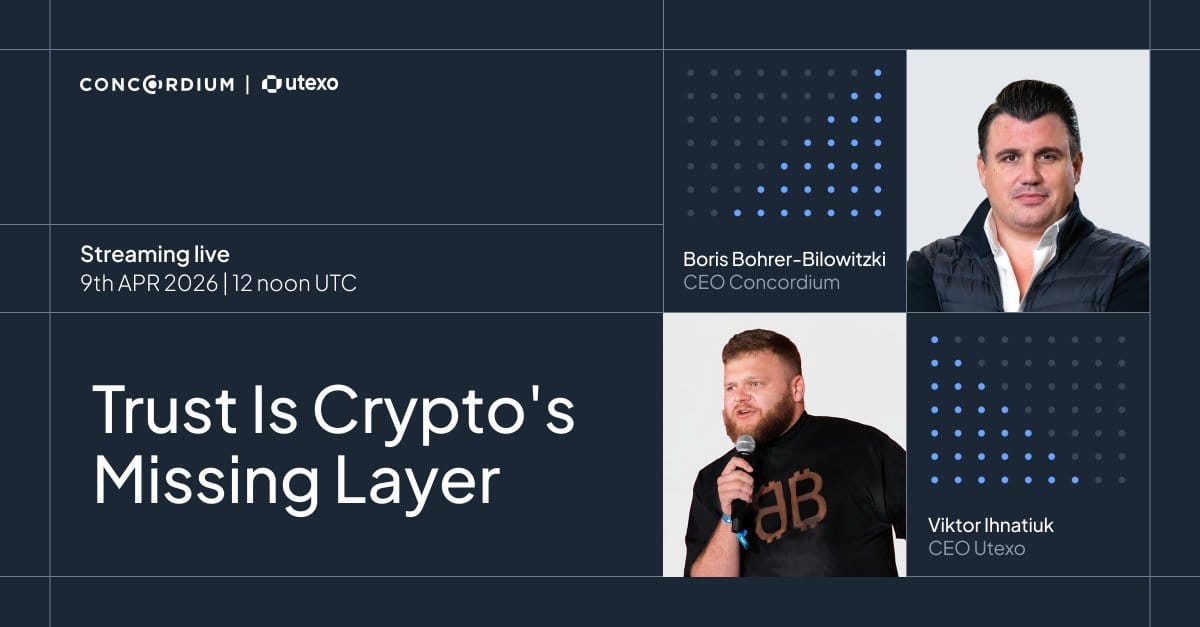
On 9 April 2026, Concordium CEO Boris Bohrer-Bilowitzki and Utexo CEO Viktor Ihnatiuk went live in a joint X Space titled "Trust is Crypto's Missing Layer." The conversation follows directly from Town Hall 5, where the agentic economy was framed as Concordium's strategic axis. This session narrows the focus to a single partnership and asks the concrete question: what does compliant stablecoin settlement actually look like when identity is built into the protocol?
The substance is very real and at times it also appears far bigger than either speaker actually seems to realize.
Viktor walks through Utexo's origin as a Tether joint venture, the RGB protocol that underpins USDT-on-Bitcoin-Lightning, and the Tricorn bridge that has connected Utexo to Concordium since 2023.
He then outlines an end-to-end flow where freshly minted USDT lands on Concordium, held by verified parties, used for B2B activity, and settled back out to Bitcoin.
If that flow goes live as described, Concordium becomes the identity-native chain where freshly minted USDT, anchored to Bitcoin via RGB and settled over Lightning, actually resides and moves between verified parties.
Boris, for his part, connects this to the broader agentic thesis and makes the protocol-vs-application-layer argument that distinguishes Concordium from every other chain attempting compliance after the fact.
The conversation is raw, unscripted, and at times loses its own thread, but the underlying architecture is absolutely worth the effort to unpack.
1. Framing: From Access to Utility, and Why Identity Is the Missing Layer
- Conversation sits at the intersection of payments, compliance, and what comes next when AI agents transact at scale
- Timing called out as exactly right
- Viktor introduced as CEO of Utexo
- Leading platform for USDT settlement on Bitcoin's Lightning network
- Tether stack already powers around 2 million companies
- Boris on the distinction that matters: building, not talking
- One-line definition of Concordium for newcomers
- On-chain identity for humans and AI agents
- Verifiable credentials and compliance-ready rails at global scale
- All in one stack
- First to build it, arguably too early, now exactly what the market needs
- Crypto's conversation has shifted
- From access (capital in, dubious projects) to utility (build, settle, verify against the real world)
- Asking the utility question seriously leads straight to the payments and identity problem
- Where Concordium and Utexo both sit
2. How Utexo Got Built: Tether, RGB, Lightning, and the Concordium Connection
- Utexo started in 2023 as a joint venture with Tether
- Origin: Viktor's previous company Boosty Labs ran a venture arm focused on Bitcoin and Lightning innovations
- Tether approached after seeing the venture studio model and proposed launching something together
- First joint venture focused on RGB
- RGB issues tokens on top of Bitcoin using client-side validation
- Lightweight transactions: data lives wallet-side, only proofs posted to Bitcoin
- Wallet acts as the peer-to-peer transfer layer
- RGB history
- Originally architected around 2017 by Giacomo Zucco and Peter Todd
- Built as a more efficient successor to Omni, the original layer USDT lived on
- Tether funded Lightning network development to place RGB over Lightning, after earlier attempts to run Omni over Lightning failed
- The merger that created Utexo
- The Tether-backed RGB development company (RGBOS, "the Tether stack") merged with Tricorn
- Tricorn was another Boosty Labs venture portfolio company, building cross-chain bridging
- Tricorn had been a Concordium partner since 2023, and Concordium was one of the first chains it bridged to
- The merger of the Tether stack and Tricorn produced Utexo
- What Utexo does
- Issues USDT over Bitcoin via Lightning
- Integrates USDT-over-Bitcoin support across major exchanges, wallets, Fireblocks, and custody providers
- Mission: bring USDT back home to Bitcoin where it originally started
- Why the Concordium collaboration
- Agent payments need identity
- Viktor's first encounter with Concordium in 2023: identity didn't initially catch his attention
- Realisation came later: real adoption requires following regulators, and regulators require verified identity over wallets and any party in the payment flow
- ZK-proof and ZK-passport startups only began appearing roughly a year later; Concordium had been building this since 2018
- Recognition of the founding team
- Lars Seier Christensen called out as a legend in FX, Saxo Bank a name Viktor knew since childhood
- The big purpose
- Regulated activities with USDT
- Potential to bring USDT into the FX market, which requires identity in place
- Saxo + Concordium + Utexo framed as one of multiple use cases
3. The Broken Compliance Stack and Where the Gap Sits
- Working with most issuers is expensive and misses the use case
- Tether stands apart: focused on usage and utility, not gatekeeping
- Regulated industries have been patching a broken stack for years
- Card bans, rising chargebacks, friction stacked on friction
- Payments is the obvious use case, both day-to-day and in the agentic economy
- Micropayments (pay-per-API, pay-per-action) are currently hard to monetize on existing rails
- KYC as implemented kills conversion before the user reaches checkout
- Operators want to be compliant
- The tools were never built for them
- Concordium was building identity during the DeFi hype, when the market wanted punks and apes
- Looked irrelevant at the time, looks essential now
- Crypto sold itself on speed but never solved for identity or compliance
- Result: fast payments that don't meet regulatory requirements
- That gap has been sitting open for years
- The Concordium / Utexo partnership closes it on both the agent side and in adjacent use cases like online gambling
4. FX, Manual Remittances, and the USDT Compliance Use Case
- The partnership solves primarily regulatory friction for operators and PSPs
- FX as the first concrete example
- FX (e.g. Saxo) is bank-to-bank infrastructure trading currency pairs, not delivering cash
- The moment a bank wants to move value out as USDT (or any tokenized form), an identity layer is required
- Without it, banks won't touch the rail: regulator risk, license risk, no visibility into counterparty
- Where the partnership lands: Utexo (with Tether expansion support) sells into FX brokers like Saxo, Concordium provides the identity layer that makes country- and counterparty-specific trading pairs viable
- Manual remittances as the second example
- Standard flow today: on-ramp local currency → buy USD → buy USDT → send → reverse on the other side
- Functional, but no identity attached to the value transfer
- At size, the receiving supplier, bank, or payment company has no basis to accept the funds
- The wallet-scoring problem
- Firms like Crystal Blockchain and Chainalysis assign risk scores to wallets holding USDT
- iGaming operators in particular are afraid of low-scored wallets and constantly looking for ways to keep their USDT in a bucket that won't be blocked
- Identity solves this directly: a verifiable trail of trusted-party-to-trusted-party transfer
- Even if a Tether freeze hits an account, a Concordium-backed disclosure of sender and receiver can support unblocking
- The "shadow bank" critique of USDT
- Real problem: USDT is used globally by mostly good actors and some bad ones
- Good actors don't want association with bad actors
- Concordium identity gives regulated entities a compliant lane into USDT without giving up the asset
- The end-to-end flow Viktor describes as the biggest use case in the partnership
- Regulated entity goes to Utexo, mints fresh USDT (Utexo and Concordium already integrated via Tricorn)
- Fresh-mint guarantee: nothing in the asset's history to flag
- The fresh USDT lands on Concordium, held by a Concordium-verified party
- B2B activity happens on Concordium, where every counterparty is identified
- Settlement back out to Bitcoin Lightning (preferred), or to Tron or Ethereum if needed
- Net effect: USDT transactions that are compatible with any regulation, end to end
5. Protocol Layer vs Application Layer: Why Concordium Is Architecturally Different
- People are increasingly asking the right questions, but a gap remains in how they read "successful" projects against Concordium
- Concordium is not yet on the first page of CoinMarketCap (YET !!!!)
- That visibility gap obscures the architectural distinction that actually matters
- Compliance solutions on other chains all live at the application layer
- Those chains were not built for compliance from the outset
- They were built on an anonymity-first thesis
- Anonymity and privacy preservation are not the same thing
- Conflating them is the source of most of the confusion in the market
- Building identity into the protocol layer (Concordium's choice from day one) opens use cases that remain closed on application-layer setups
- This protocol-layer foundation is what makes the Utexo partnership and the wider Tether-ecosystem use cases possible
6. The Agentic Economy and the Accountability Question
- Most people are still blind to what is happening in front of them
- A lot of talk about what AI agents can do
- Almost no one asks the right question: how do we know who is responsible when they do it
- Verification is the only unlock
- The agentic economy is already forming
- Agents already book travel, execute trades, run prediction-market setups, manage supply chains, handle workflows
- All of this is happening on infrastructure built for humans: slow, leaky, unaccountable
- Concordium's positioning predates the current agentic wave
- Lars was already focused on AI in early 2024 when Boris signed on as CEO
- Boris admits at the time it felt slightly early
- PLTs (Protocol Level Tokens) and PLLs (Protocol Level Locks), built on top of identity from day one, were the prelude to agentic infrastructure
- Concordium now has a "very clear plan" for becoming the dominant force in the agentic economy
- Agent transactions almost always involve moving money
- Paying for APIs
- Managing subscriptions (Boris admits he has no idea how many he is paying for)
- Settling invoices
- Executing trades
- The accountability gap is fundamentally different for agents than for humans
- When a human pays, identity is implicit (bank onboarding, card issuer knows the holder)
- When an agent pays, the questions multiply: who is this agent, is it authorized, can it settle compliantly on both sides
- What Concordium provides, now extended through Utexo
- Agents can carry verifiable zero-knowledge credentials
- Counterparty or regulator can confirm legitimacy without accessing the underlying data
- The football stadium analogy: you do not walk in flashing your social security number, you want a level of privacy that does not exist in today's onboarding-for-everything world
- Strategic positioning of the partnership
- Gaming and high-risk payments: the proof of concept (already delivered last year)
- Agentic economy: where the infrastructure really scales
- This is why the Utexo collaboration matters now
7. What Agentic Scale Actually Requires: Identity, Connectivity, Lightning, Compliant Privacy
- Boris frames the question: not TPS, but infrastructural scale
- TPS is not the bottleneck (the Solana 15-million-TPS framing is dismissed as irrelevant)
- Real question: what does the agent economy actually need to prosper
- Viktor's four requirements
- Identity layer first
- References Concordium's recent partnership with Coinbase's x402 as evidence the market is converging on this need
- Connectivity second
- x402 doing valuable work connecting different providers for joint agentic payment flows
- TPS is not the problem (Lightning solves it)
- Lightning has no block time or block size limit
- "If you need 1 billion transactions per second, I will give it to you because it's Lightning"
- Blockchains were never built for payments, they were built for settlement
- Solana, Monad and similar were created for payments at small scale, but the architecture doesn't extend
- Compliant privacy
- Privacy is needed: nobody wants the whole world watching their transactions
- But pure privacy lets bad actors hide
- Bitcoin's UTXO model is the unlock: every UTXO is a "paper bill" that can be tracked, marked, or blocked, mirroring how cash works in the real economy
- Utexo gives privacy with compliance
- Identity layer first
- The four-way stack
- Concordium (identity) + Utexo (settlement) + USDT (asset) + Lightning (rails)
- Unlimited TPS, privacy, compliance, and connectivity in one configuration
- Acknowledged gap: still need fiat on/off-ramp providers
- Boris's aside on onboarding
- Existing fiat onboarding is brutal
- Forward-thinking AI-focused businesses can play a role here
- Boris's broader framing of the agentic moment
- Crypto has cycled through NFTs, DeFi, and other narratives, with a few "winners" emerging
- Doubts those winners will continue to lead, because what Concordium can do, Ethereum simply cannot
8. What Operators and PSPs Should Watch Over the Next 6 to 12 Months
- Boris's question: what will leave certain businesses on the side of the road while others fly
- Viktor splits the answer into business and technical
- Business side: pay attention to stablecoin development
- Enormous capital, energy and talent flowing into different stablecoin implementations
- The space will converge on a few simple solutions
- Two frictions that will get solved:
- On/off-ramp pricing
- FX pricing
- Once those two are solved, "everyone who is not using stablecoins will just die"
- The only real problem with stablecoins for payments today is the cost of using them, because on/off-ramps are expensive
- For some use cases it is currently cheaper to use providers like Shift4 without touching stablecoins at all
- Once the two frictions go away, traditional finance rails will start to fade
- Technical side: understand the actual crypto-processing market
- Crypto processing is roughly 5–8% of total payment processing
- For operators with meaningful stablecoin flow, look for real solutions
- For US-facing iGaming operators specifically: Concordium payment solutions make stablecoin payments compliant
- The exchange-account reality nobody talks about
- The general crypto user keeps their money on exchanges, not in non-custodial wallets
- Users pay from exchange accounts, not from MetaMask
- "No one cares about non-custodial experience, sadly"
- 70–80% of crypto casino deposits come from exchange (CEX) accounts
- Implication for crypto-processing developers
- Solve for real adoption problems, not the cypherpunk non-custodial ideal
- Simplify the user flow for depositing directly from exchanges
- Both flows can coexist, but the exchange-deposit path is where the actual volume sits
- VIPs and analytics
- Most casino VIPs (the high-value players who drive revenue) also pay from exchange accounts
- Analytics tools built around non-custodial wallet data will show incomplete data
- Anyone automating crypto-processing analytics needs to factor this in