Understanding Zero-Knowledge Proofs The Privacy Infrastructure Powering Trust
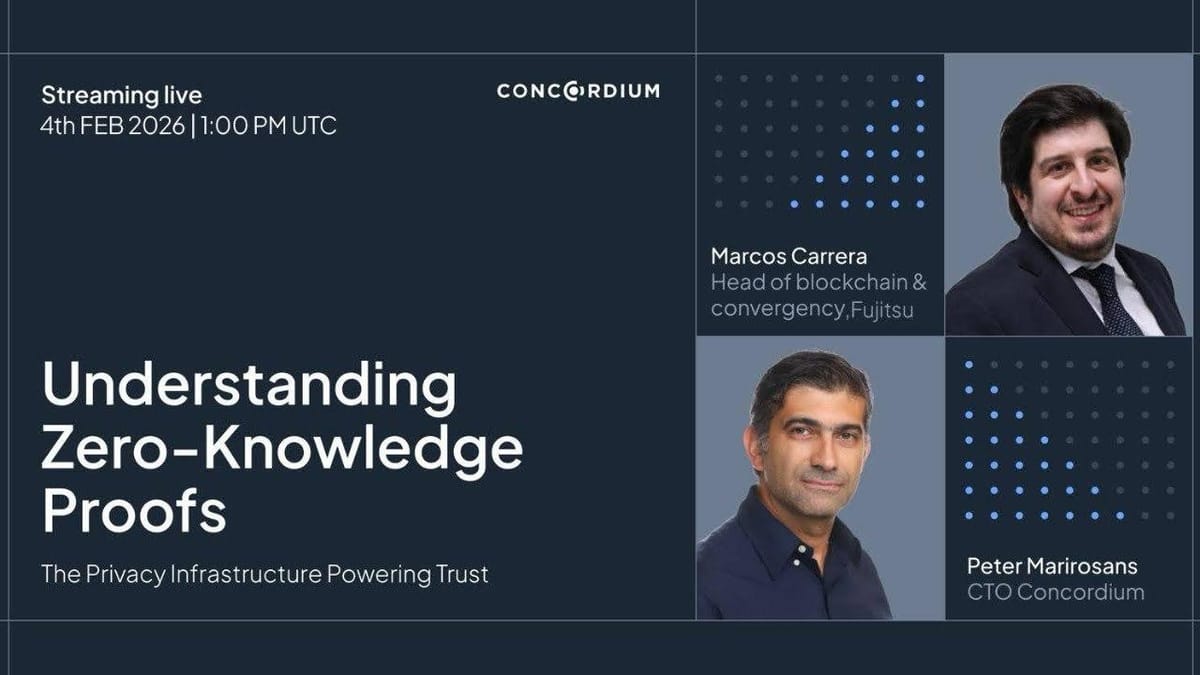
On the surface, this was a technical discussion about Zero-Knowledge technology, identity, compliance, and privacy. But that reading misses the real signal. What we just witnessed went beyond a feature conversation, it was an infrastructure conversation.
Regulation, identity frameworks, AI agents, medical data portability, critical infrastructure, and even national security were all touched in a single thread, outlining how and where Zero-Knowledge moves from being a cryptographic concept into becoming a structural layer of the digital world. At the same time, the session exposed the recurring gap between technological substance and how it is articulated. The academic foundation behind the technology is world-class. The strategic domains mentioned are trillion-dollar territories. Fujitsu, the institutional partner on stage is a global systems integrator and still, the narrative often floats at a general level where the magnitude is merely implied rather than asserted.
The real takeaway is as much about what this combination represents as it is about what was said: ZK is moving out of the crypto niche and into identity infrastructure, regulatory architecture, AI ecosystems, and state-level security logic. We are about to enter the phase where Zero-Knowledge stops being “privacy tech” and starts becoming governance-compatible infrastructure and that shift is actually far more significant than the conversation itself managed to express.
1 Opening & Framing
- Marco Carerra:
- Zero-knowledge = “huge strength”
- Market challenges linked to lack of understanding of this strength
- Peter Marirosans:
- Aligns with framing
- Objective: help others understand the value they already see
- Immediate positioning
- Focus = education & clarity
- Barrier = comprehension gap, not technology limitation
2 Introductions & Strategic Framing
- Peter Marirosans (CTO, Concordium):
- Opens formal introductions
- Blockchain background (multi-year involvement)
- Past year focused on Concordium chain
- Positions Concordium around:
- Zero knowledge
- Identity
- Broader infrastructure opportunity
- Signals strong belief in project potential
- Marco Carerra (Head of Blockchain & Convergence, Fujitsu):
- Leads blockchain & convergence domain
- Focus areas include:
- Agents
- Quantum / post-quantum
- Blockchain integration
- ZK described as one of the best fits for enabling real blockchain utility
- Approximately 10 years across:
- Startups
- Institutional environments
- Acknowledges weak market conditions
- Contrasts with:
- Growing real-world usage
- Long-term tech trajectory
- Expresses conviction in technology’s forward impact
- Mutual close to intro:
- Alignment on opportunity
- Transition into technical discussion phase
3 The Core Challenge: Explaining Zero-Knowledge
- Peter Marirosans:
- Key issue = explaining ZK to non-technical people
- Even family-level explanations fail
- Core confusion:
- “Proving something without knowing anything”
- Requests analogies to make concept understandable
- Marco Carerra:
- Confirms communication challenge with non-digital audiences
- Defines ZK principle:
- Prove something
- Without revealing the real data / document
- Emphasizes foundation:
- Mathematics
- Cryptography
- Trust model shift:
- Trust placed in math, not intermediaries
4 Analogies & Trust Model
- Peter Marirosans: PIN analogy
- Giving PIN = revealing secret (bad)
- Withdrawing cash in front of you:
- Proves PIN knowledge
- Secret never disclosed
- Core idea:
- Prove possession of secret
- Without revealing secret itself
- Marco Carerra: access control analogy
- Entering a place:
- No credential shown
- Outcome proves authorization
- Entering a place:
- Shared framing
- ZK = proof without data disclosure
- Moves trust from institutions to mathematics / cryptography
- Marco adds:
- Supports GDPR & regulatory compliance
- Not new tech
- Now critical because blockchain needs it
- ZK = “perfect fit” for current infrastructure layer
5 Why Now (Timing)
- ZK principles date back to ~1980s
- Not new technology
- What changed
- Massive digitization of information
- Data now structured for:
- Mathematical processing
- Systematic cryptographic use
- Population readiness increased:
- Comfortable with digital identity
- Familiar with electronic data storage
- Understands information flow between systems
6 Enterprise Pain (Data Risk & Cost)
- Corporate outlook (next 1–3 years):
- Major pain = hacking / data breaches
- Focus on:
- Source data
- GDPR data
- Strategic / sensitive data
- Business impact:
- Continuous high spend on data protection
- Security cost = structural burden
- ZK positioned as:
- Solution to real enterprise problem
- Security growth area
- Societal framing:
- Individuals reduced to “data” / “numbers”
- Digital exposure normalized
- Privacy demand:
- Users willing to pay for protection
7 Privacy “Full Circle” (Loss of Boundaries → Need for ZK)
- Society previously:
- Cautious with personal data
- Would not share:
- Address
- Date of birth
- Preferences
- Shift occurred:
- Data given away unconsciously
- Physical privacy barriers disappeared
- Analogy:
- Merchant at football club = contextual, acceptable
- Merchant following you home = invasive tracking
- Digital environment:
- Constant visibility
- Continuous behavioral tracking
- Normalized consent to surveillance
- Societal shift:
- Awareness increasing
- Desire to reclaim control
- ZK positioned as:
- Tool to restore privacy boundaries
- Protection for:
- Data
- Behavioral patterns
8 Identity as the Anchor Use Case
- Recognition:
- Data concentrated in central hubs
- Desire to regain control over personal data
- Identity = primary domain:
- Control should sit with user, not intermediaries
- Concordium identity layer positioned as solution
- ZK-enabled claims:
- Prove age
- Prove jurisdiction
- Prove identity validity
- Without sharing passports / licenses / raw documents
- Enterprise angle (Marco):
- Large firms working on digital identity frameworks
- Concern: protecting digital identity / “digital passport”
- Compliance tension:
- Audits require data exposure
- Risk:
- Value chain visibility
- Competitive leakage
- Current reality:
- Repeated identity checks normalized
- Scans + selfies sent everywhere
- Multiple copies of identity stored across systems
9 Medical Data Portability & Selective Disclosure
- Use case introduced: medical data (incl. or perhaps exclusively for children) when traveling internationally
- Current limitation:
- No practical way to share needed medical data
- Without exposing full sensitive records
- ZK + blockchain enable:
- Partial data disclosure
- Only medically required information shown
- Remaining data stays protected
- Consent model:
- Digital / eConsent mechanism
- Temporary access for doctor
- Access can be revoked afterward
- Framing:
- Example of capability people don’t realize exists
10 ZK as Invisible Infrastructure
- Gap acknowledged:
- Experts enjoy deep technical discussion
- General population does not
- Technology maturity stage:
- Should be used without being seen
- Encryption analogy:
- Users see “your chat is encrypted”
- Do not understand mechanics
- Still trust the system
- Projection:
- Blockchain + ZK will move to same layer
- Fades into background
- Trusted, not examined
- Use-case layer sits above:
- Example: medical access abroad
- Identity verification + consent
- No physical records carried
11 Usability, Simplicity & Delivery Model
- Product principle:
- Simplicity > cryptographic sophistication
- Applications should look like traditional apps
- No visible blockchain/crypto layer
- Team requirement:
- Not only cryptographers
- Mixed skill sets needed
- UX-first development
- Adoption logic:
- Especially critical for non-digital / senior users
- Interaction model = “send data → done”
- Concordium positioning:
- Identity embedded in chain infrastructure
- Users don’t need to understand mechanics
- Trust derived from:
- Verifiable code
- Invisible backend
- Merchant flow example:
- Identity app scan
- Consent prompt
- Age verification completed
- No seed phrases / blockchain handling
- Real-world example:
- “Digital passport” use case
- Farmers / non-digital users
- Photo + send flow
- Regulatory compliance in background
- Conceptual shift:
- Encryption → protects communication
- ZK → protects privacy
12 Regulation, Compliance & Auditability
- Regulation discussion introduced:
- Need to balance:
- Protection
- Monitoring
- Avoid over-intrusion
- Need to balance:
- Regulated sectors highlighted:
- Pharma
- Health
- Finance
- Insurance
- Core compliance need:
- GDPR alignment
- Data protection
- Financial transparency requirements
- ZK positioning:
- Privacy by design
- Data protection embedded in architecture
- Forward-looking view (Marco):
- Future MiCA evolution may include / recommend ZK
- Institutions require privacy-preserving infrastructure
- ZK seen as enabler for institutional adoption
- Identity/privacy frameworks:
- ZK technologies linked to improved privacy standards
- Concordium stance (Peter):
- Active regulator dialogue
- System includes:
- Zero-knowledge proofs
- Immutable on-chain audit anchor
- Merchant compliance benefit:
- Can prove checks were done
- Evidence replayable
- Audit-friendly without exposing user data
13 Anchoring Strategy, Scaling & Regulatory Balance
- Client question:
- “Do we need to anchor every data?” → No!
- Design principle:
- Anchor evidence / commitments only
- Not raw or full datasets
- Benefits:
- Reduced energy use
- Lower computational load
- Necessary for scalability
- Public-chain consideration:
- Over-anchoring increases profiling risk
- Even protected data patterns can be analyzed
- Implementation flexibility:
- Anchoring frequency depends on use case
- Options:
- Per event
- Periodic (hourly / weekly)
- Regulatory dimension:
- ZK allows monitoring without data exposure
- Merchant age-check example:
- User data never revealed
- Regulator can still audit process
- Governance boundary:
- Ongoing debate:
- Privacy vs oversight limits
- Ongoing debate:
- Disclosure framework:
- Extreme legal cases may allow identification
- Controlled, exceptional mechanism
14 Mixers vs ZK & “Proof of Evidence”
- Reference event:
- Tornado Cash situation (USA)
- Seen as overreach / mistake
- Regulatory confusion:
- Mixers ≠ ZK
- Privacy tools being grouped incorrectly
- Distinction:
- Mixers → transaction obfuscation
- ZK → data protection + validation
- Core reframing:
- ZK = “proof of evidence”
- Not hiding activity
- Proving correctness without revealing data
15 Mindset Shift: Data → Proofs
- System design shift:
- Do not handle raw data
- Work with "proof of evidence”
- Old model:
- Reveal information
- Institution says “trust me, I’ll protect it”
- ZK model:
- Do not reveal
- Provide proof instead
- Safety on both sides
- Developer / enterprise implication:
- Requires different architecture thinking
- Data transformed into proof objects
- Early business traction:
- Insurance sector
- Use cases:
- Fraud reduction
- Risk control
- Privacy in guarantees
- Margin improvement potential highlighted
- Use cases:
- Insurance sector
- Adoption driver:
- Must connect ZK to concrete pain points
- Requires organizational mindset change
- Regulatory pressure example:
- Age verification mandates
- ZK allows:
- Access without identity exposure
- Merchant protection
- Regulatory alignment
- Market barrier:
- Corporations struggling due to wrong technology choices
- Need education + correct stack
- Transparency vs privacy:
- Can coexist via proof systems
- ZK = mechanism enabling both
- Governance balance:
- Too private = unsafe
- Too exposed = unsafe
- Midpoint required
- Global digital reality:
- Behavior visible worldwide
- Need protection of behavioral data
16 AI Agents & Emerging Privacy Risks
- Trend:
- Agents interacting with other agents
- Autonomous data exchange increasing
- Risk identified:
- Agents sharing:
- Personal data
- Documents
- User-provided information
- Lack of visibility into:
- Where data goes
- How it is used
- Agents sharing:
- Anticipated evolution:
- Emergence of ZK-enabled agents (“CK agents”)
- Agents that protect data during interaction
- Broader environment:
- Convergence of:
- Privacy concerns
- Blockchain
- Centralization vs decentralization
- AI vs human agents
- Convergence of:
- Reaffirmed principle:
- Core need = privacy + protection
- Technology maturity now enables self-protection mechanisms
17 Architecture & Scalability Principles
- Client concern:
- Transaction load / system stress
- Question framed as capacity problem
- Clarification:
- Not a volume limitation issue
- Technology must be used selectively
- Core design rule:
- Do not index all data
- Anchor only specific commitments
- Outcome:
- Full-chain traceability preserved
- Privacy maintained
- Compliance requirements met
- Key conclusion:
- Scaling depends on architecture design, not chain limits
18 Practical ZK Verification Flow (Concordium Example)
- Purpose:
- Concrete explanation to improve understanding
- Adoption expected to follow comprehension
- Flow
- Step 1 — Identity verification
- User verifies with identity provider
- Data remains on device
- Protected via encryption
- Step 2 — Commitment anchoring
- Commitment written to chain
- Prevents tampering
- Creates immutable reference
- Step 3 — Verification request
- Merchant asks: prove age
- Old model: reveal DOB
- ZK model: prove age range (18–100)
- Step 4 — Proof validation
- Merchant checks proof against on-chain anchor
- No personal data revealed
- Step 1 — Identity verification
- Stakeholder outcomes
- User:
- Data never leaves device
- Privacy preserved
- Merchant:
- No custody of personal data
- Reduced GDPR / breach liability
- Regulator:
- Can audit via on-chain evidence
- Verification replayable
- Compliance provable
- User:
- Adoption logic
- Understanding → trust → merchant adoption → user adoption
19 Industry Adoption Outlook
- Question raised: which industries adopt ZK next?
- Healthcare:
- Identity + sensitive data use cases
- Insurance:
- Already aligned with fraud / risk logic
- Adult industry:
- Immediate age-verification need
- Social media:
- User validation without data harvesting
- Dating platforms:
- Identity assurance without exposure
- Gaming:
- Age segmentation
- Adult vs child interaction controls
- Offline/physical layer:
- Bar entry
- Events / concerts
- Ticket ownership validation
- Healthcare:
- Use-case pattern:
- Prove entitlement
- Without revealing identity
20 Military & Critical Infrastructure
- Marco introduces new domain:
- Military use
- Critical infrastructure
- Context:
- Significant investment in Europe & UK
- Government-level priority area
- Infrastructure types mentioned:
- Weather systems
- Water
- Electrical systems
- ZK value proposition:
- Protection of critical systems
- Addresses major security “pains”
- Adoption requirement:
- Must be explained in simple terms to governments
- Positioning = stronger protection via technology
- Peter response:
- Defense historically core driver of tech
- Aligns with ZK as next phase application
- Close:
- Confirmed mutual interest in collaboration
21 Closing & Collaboration Outlook
- Peter signals session wrap-up
- Emphasizes value of idea exchange
- Suggests continued dialogue
- Reaffirms ongoing collaboration
- Marco:
- Thanks for invitation
- Expresses enthusiasm
- Highlights “huge opportunity”
- Mutual close:
- Alignment on future cooperation