What an Unscripted X Space Between Two CEOs Revealed About Where Stablecoins Are Actually Heading
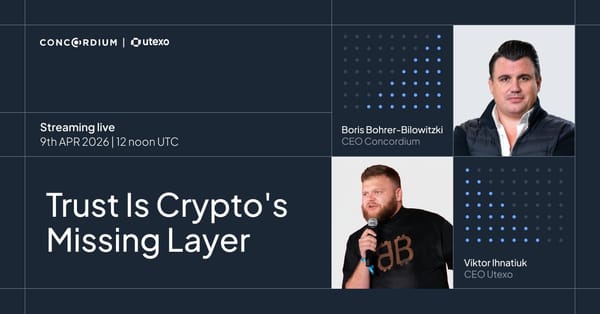
On April 9, Concordium CEO Boris Bohrer-Bilowitzki and Utexo CEO Viktor Ihnatiuk went live in a joint X Space. No slides, no script, no rehearsal. The title was "Trust is Crypto's Missing Layer." Most of it sounded like a standard partnership conversation.
It was not.
Buried inside roughly 40 minutes of unstructured dialogue were three insights that matter far more than the initial partnership announcement suggested. Each one deserves serious attention from anyone building payment infrastructure, processing stablecoins, or thinking about what compliant crypto flows actually look like at scale.
TLDR: Three insights from the Utexo x Concordium X Space
1. Freshly minted USDT may actually reside and move on Concordium, making it the first identity-native chain where compliant stablecoin value flows between verified parties.
2. 70-80% of crypto casino deposits come from exchange accounts, not wallets. The non-custodial thesis is wrong about where the money actually flows.
3. Blockchains were built for settlement, not payments. Lightning is the only layer that scales, and Utexo has already placed USDT on top of it via RGB.
1. Freshly Minted USDT May Actually Reside and Move on an Identity-Native Chain
Viktor Ihnatiuk's company Utexo started in 2023 as a joint venture with Tether, issuing USDT over Bitcoin via the RGB protocol and Lightning Network. Before Utexo existed, Viktor's venture studio Boosty Labs had already built Tricorn, a cross-chain bridging company that has been a Concordium partner since 2023, with Concordium as one of the first chains it bridged to.
That history matters, because in the X Space, Viktor described an end-to-end compliance flow that runs directly through this existing Tricorn bridge infrastructure.
His words:
"Once you get this freshly minted USDT on Concordium, you are a hundred percent sure that it is fresh and it's kept by someone whom Concordium already verified."
The architecture he outlines: Utexo mints fresh USDT on RGB (Bitcoin's client-side-validated smart contract protocol), bridges it to Concordium via the existing Tricorn bridge, and the USDT lands on Concordium held by a verified party. B2B activity happens on-chain between identified counterparties. Settlement routes back out to Bitcoin Lightning, or to Tron or Ethereum if needed.
If this flow goes live as described, Concordium becomes the identity-native chain where freshly minted USDT, anchored to Bitcoin via RGB and settled over Lightning, actually resides and moves between verified parties.
There is no equivalent configuration in crypto today. Bitcoin provides the settlement anchor. RGB provides the smart contract and privacy layer. Lightning provides the throughput. Tether provides the asset. Utexo operates issuance and settlement. Concordium provides the protocol-level identity that makes every participant in the flow verifiable without exposing underlying data.
That is six layers, each with a distinct function, assembled into a single compliant value flow. It also means that USDT could move between parties on a chain where identity is enforced at the protocol level rather than bolted on as an application-layer afterthought. Boris made this point explicitly:
"Those compliance solutions unfortunately all live in an application layer because those chains didn't really build for that from the outset." And separately: "Privacy preservation and anonymity are two completely different things."
2. The Non-Custodial Religion Is Wrong About Where the Money Actually Flows
Viktor dropped a number that should make every crypto-native payment builder pause.
"Most crypto casino deposits are happening from an exchange account. Like 80% or 70%, something like this."
He then went further:
"No one cares about non-custodial experience, sadly."
Viktor is clearly an operator grounded in reality, saying on record what most of the industry privately knows but publicly avoids: the vast majority of crypto payment activity, particularly from high-value users, originates from centralized exchange accounts. Users are paying from Binance, from Coinbase or from Kraken, they are simply not connecting MetaMask.
The strategic implication is direct. If 70-80% of high-value crypto activity originates on exchanges, then any identity or compliance layer seeking real adoption has to integrate with the exchange flow, not just with the wallet flow. The realistic path to relevance therefore runs through deep exchange partnerships and exchange-to-merchant rails, not through convincing retail users to self-custody.
For developers building crypto-processing tools, this also means that analytics built around on-chain wallet data will produce structurally incomplete pictures of actual user behavior. Viktor's advice to developers was blunt:
"Look for how you will solve a real problem for crypto adoption. Not for a cypherpunk non-custodial experience."
3. Blockchains Were Built for Settlement, and Lightning Is the Only Payments Layer That Actually Scales
In a part of the conversation that touched on what large-scale transaction volume requires, Boris dismissed the TPS arms race outright:
"This whole Solana, 15 million transactions per second... this is not a problem we have right now."
Viktor's response reframed the question entirely:
"Blockchains were never created for payments. Blockchains were created for settlements."
This is technically precise and historically accurate. Bitcoin's ten-minute block times and limited throughput are essentially the design choices of a settlement system, not a payments system. Even the Bitcoin community itself settled this debate during the 2015-2017 block size wars: the base layer is for settlement, payments belong on a second layer. That second layer is Lightning.
Viktor's claim for Lightning was direct:
"If you tell me you need 1 billion transactions per second, I will give it to you because it's Lightning. I have no limitation of block time and block size."
What makes this relevant beyond the usual Lightning advocacy is that Utexo has placed USDT on top of Lightning via RGB. This is in other words more than a theoretical scaling argument. It is a live infrastructure claim: stablecoin payments at unlimited throughput, with compliant privacy via RGB's client-side validation (where transaction data stays in wallets and only cryptographic proofs are anchored to Bitcoin), and with identity verification via Concordium.
Viktor's summary of the combined stack:
"With Concordium, with Utexo, and with USDT, we can create the best solution because we have unlimited TPS, we have privacy but still compliance, and we have connectivity."
What This Means
The partnership announcement positioned Concordium as a compliance layer alongside Utexo. But the X Space revealed a more ambitious architecture, a six-layer stack where:
- Bitcoin anchors settlement
- RGB handles smart contracts and privacy
- Lightning delivers throughput
- Tether provides the asset
- Utexo operates issuance and settlement
- Concordium provides protocol-level identity for every participant in the flow
Whether this architecture delivers on its promise depends on execution. Utexo is still in early stages, constrained by the limited number of wallets currently supporting Tether's Wallet Development Kit. The iGaming vertical is the realistic near-term proving ground.
Viktor, for his part, described a broader destination for the partnership: compliant USDT settlement for FX brokers, a cleaner remittance flow, and a structural answer to the shadow-banking critique that has followed Tether for years.
What truly matters is that the underlying primitive, verified-identity USDT moving through a Bitcoin-anchored, Lightning-settled, identity-native value flow, is genuinely new. If it works, it changes the entire conversation about what compliant stablecoin infrastructure looks like. Crypto moves from compliance bolted onto anonymous chains after the fact, to compliance built into the protocol from day one, with value actually moving through it.
That is worth paying attention to.