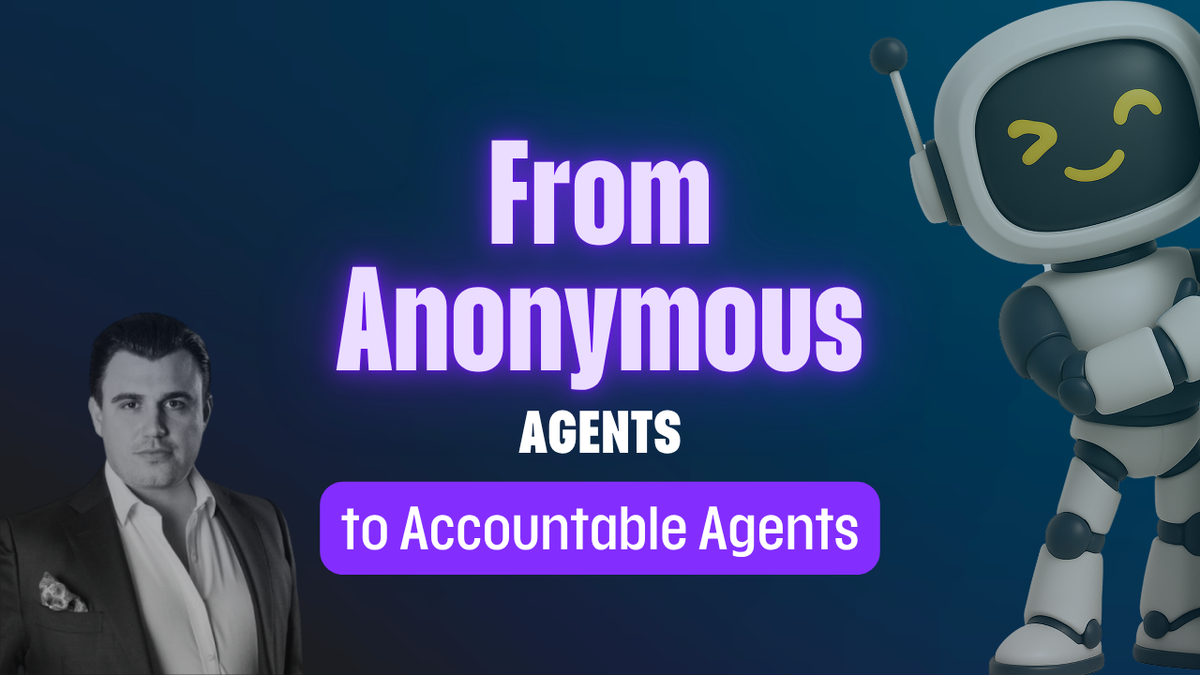
From Anonymous Agents to Accountable Agents
Every major economic leap has taken the same shape. We handed physical labour to engines, calculation to computers, and communication to networks. Each time humans stepped back and let the machine carry more.
The agentic economy hands over something more personal: judgment. An AI agent now decides and acts on your behalf while you are elsewhere.
That is where this conversatio
n begins. The moment your agent signs a contract, orders a service, or moves money, an old question resurfaces, one that centuries of law already settled for people and companies. Who stands behind it? A name, a jurisdiction, someone liability can attach to. Agents move at machine speed, and that backing is still being built. They are, in Boris Bohrer-Bilowitzki's words, ghosts.
In his second X Space with BanditXBT, the Concordium CEO walks through how you give a ghost a face: an identity layer that proves a real, accountable human or business sits behind an agent, while their private details stay private.
1: The AI trajectory and the accountability gap
Bandit frames the opening question around lived experience with AI's pace
- Recalls first using ChatGPT as a substitute teacher to generate student assignments from nothing
- Contrasts that with today: agents transacting, agents finding hacks, the "cloud mythos" reference
- Asks where AI lands in three years given the last two to three years of acceleration
- Boris positions AI as the next major economic leap, following a repeating pattern
- Each leap offloads a type of work to machines and frees human attention for higher-value tasks
- The progression: labor to engines, calculations to computers, communications to networks
- The current shift offloads judgment itself
- An agent decides and executes on your behalf without you present
- Human attention has always been the bottleneck for commerce and business
- The agentic economy removes that bottleneck entirely
- Boris declines a firm three-year forecast, citing an extreme range of outcomes
- Outcomes span from "we're all dead" to a state of remarkable efficiency
- The scale shift is already measurable across ecosystems
- Agents settled over 170 million on-chain transactions in the past year
- Virtuals launched over 17,000 agents
- Solana's Eliza OS commands roughly 70% of existing x402 volume
- Ethereum contributing its share
- The core unsolved problem: agents are powerful yet anonymous (the Concordium pivot)
- Agents are extremely capable but remain complete strangers, described as "ghosts"
- Human and business contracts carry centuries of legal infrastructure behind a signature: name, jurisdiction, liability
- When an agent acts, none of that backing exists by default
- The industry has a standard for what agents can do on-chain, yet lacks a standard for who stands behind them
- That gap creates the problems Concordium fills: identity, accountability, compliance, and trust
2: What agents actually do today
- Bandit narrows the question to the dominant real-world use case, beyond crypto
- Asks what most agents are actually being spun up to do, given Boris's vantage point
- Boris leads with Concordium's own internal use: "walk the walk"
- The company reduced headcount by a significant margin and became more efficient
- One agent delivers in half an hour what a strategy department of 15 analysts working around the clock would produce
- The same efficiency applies across the commercial, marketing, and tech streams
- Monetization is happening now, primarily through agent payments
- Agents pay for API calls via the Coinbase x402 protocol
- The Moldbook tipping service as a live example built on Concordium
- Moldbook is described as a social network for agents themselves
- The tipping service rewards comments that deliver genuinely useful insights with payment
- Built on Concordium because the payments require verification behind them
- Further real-world examples, including crypto-native ones
- Agents managing DeFi positions
- Agents negotiating SaaS contracts on behalf of companies (drawn from Boris's own network)
- The throughline: this is very real now, no longer theoretical
3: Accountability before Concordium and the authorization problem
- Bandit asks how accountability worked before Concordium when an agent acts maliciously or fails
- Boris reframes the gap: the problem is not intelligence, it is accountability
- Agents already exceed human intelligence by a wide margin
- What is missing is the accountability and trust layer
- The authorization problem stated simply
- When your agent is built to do a task and interacts with another party to fulfill it, you have no way to confirm the agent on the other side was actually authorized to handle that request
- Direct answer: until now, nobody could verify this. Concordium can, and awareness is still early
- Bandit anchors the point with the self-driving car precedent
- The responsibility question for a self-driving car accident predates AI and resists a black-and-white answer
- He had never considered the agent equivalent before encountering Concordium, and finds the framing immediately persuasive
4: Crypto as application, anonymity versus privacy, verify once
- Boris stakes out a deliberately controversial position on crypto itself
- He cares little for crypto as such, viewing it as an application with enormous potential
- The cypherpunk instinct lives in him too, so he holds no aversion to decentralization or anonymity in principle
- The regulation tension crypto has spent years avoiding
- The current market distress is his third such cycle in the industry
- Providers have rushed to brand themselves "regulated" alongside the BlackRock ETF and GENIUS Act enthusiasm
- The core problem: crypto's purely anonymous nature does not fit regulation
- Anonymity and privacy are gravely different, and most loud "privacy" advocates already KYC'd anyway
- The same people demanding complete anonymity held a newspaper and sent a selfie to exchanges to onboard
- That amounts to KYC by default
- What Concordium stands for, agentic side aside: verify once
- Today every digital service forces repeated KYC, handing over a passport or license merely to prove you are over 18
- A service has no need for your exact birth date, eye color, or address to confirm an age threshold
- On Concordium you onboard once and verify forevermore in a privacy-preserving way
- The same approach carries into the agentic economy: built for this moment
- Concordium was arguably five years too early
- The project survives while many others have died, for a reason worth digging into
- Boris's research prompt for skeptics
- Everyone now has Claude, Grok, Perplexity, or ChatGPT
- Spend 15 minutes asking which projects are genuinely doing identity, why Concordium would win, why others would win
- Also probe the natural industry instinct to bolt identity verification onto existing infrastructure as a feature
5: Crypto as movement and the natural money for agents
- Bandit relates to the tool framing through his own seven-year history in crypto
- When he started, none of the current "CT" culture existed
- Crypto then felt more like a movement than anything else
- Boris agrees the movement spirit was real and persists, though it has morphed
- Both dismiss the drift into lifestyle and meme-coin culture
- Bandit's path in: gaming and private money, then AI as the unlock
- Recounts the Vitalik origin story, a nerfed World of Warcraft item teaching him the harm centralized entities can do, which pointed toward a decentralized solution and Ethereum
- Gaming and private money were his natural use cases, but nothing truly stuck until AI arrived
- His logic: agents that transact need money, and crypto is the most natural fit
- Boris ties digital life to digital money, then narrows to stablecoins
- A fully digital world naturally uses digital money
- Bitcoin has specific use cases, with Lightning handling throughput
- For payments, the endpoint is a stablecoin: tethered to the existing financial system and able to generate yield
- The meme-coin reality check
- A listener hoping to pay with meme coins is out of luck for everyday bills
- An agent handling monthly bills to Sky or Thames Water will not get Pudgy Penguins accepted, since volatility rules it out
- Held as a stablecoin, the answer changes to yes
6: The agent flow dumbed down, from agent card to registration
- Bandit asks for the plain-English flow: he has an agent and wants to get on the agent trajectory
- It starts with the agent card
- Agent platforms make it easier to create the card
- The card defines what the agent is and why it exists, its raison d'être
- The standard originated with Google, and that metadata is brought into the Concordium ecosystem
- Crucially, the agent does not need to be native to Concordium: Ethereum, Solana, and Fetch agents are all catered for
- The pizza-ordering example, with two layers of trust
- You interact with your ordering agent via MCP, hooking up WhatsApp or the model directly, telling it you are heading home and want a pizza
- The agent infers context, such as a beer to go with it on a Friday
- Layer one, payment authority: the agent handles your money, so you want assurance the order goes to the real Deliveroo rather than a lookalike URL, which is how ERC-8004 verification works
- Layer two, attribute proof: ordering alcohol requires proving you are over 18, an attribute the agent can present in a fully privacy-preserving way
- Deliveroo needs only the over-18 confirmation, never the exact birth date or identity
- The agent registry attaches an accountable human or business layer
- Any agent set up anywhere gains an accountable layer through the registry
- On Concordium you can onboard as an individual or as a business
- You anchor your Concordium key, backed by your ID, alongside the agent's key on Ethereum or elsewhere
- The registry proves you control both, backed by human ID in a privacy-preserving way
- Boris's claim: no other blockchain can do this
- The registration steps in practice: roughly two clicks
- Go to concordium.com, currently near the top, and click the blue button to reach the registry
- Two views are offered: a simple view for newcomers and a technical view for developers
- Sign a transaction with a wallet such as MetaMask to prove key ownership
- From the Concordium side, the agent is now verified with a real-world ID in the background
- Bandit notes the gap between Boris's clear spoken explanation and the intimidating jargon people hit when reading
7: Speed of change and why crypto failed on UX
- Boris concedes it is a lot to absorb, but the defining factor is speed
- He stops short of promising universal agent adoption by November
- In 12 to 18 months it should be as simple as the two-button Apple Pay gesture on a phone
- Why crypto failed, in his view: tooling and access were too complicated
- The dinner-party test: explaining "I'm in crypto" always collapsed into people trying to understand it
- His refrain from last year: you should not need to understand the blockchain, you should just use it
- The industry failed by not abstracting away the complexity
- The seed phrase as the emblem of that failure
- People were asked to grasp a 24-word mnemonic, store it safely, and accept that losing it plus their device meant losing all their money
- Friction like this blocked proper adoption
- Why this moment is different: AI collapses the skill barrier
- Boris, a non-developer, can now build apps as capable as the work of someone with three or four years of engineering study
- Plain-English prompting produces apps, games, and code, and the same principle extends to any use case
- Compliance will not disappear, and business-level agent interaction is already normal
- People increasingly interact with agents on a business level without even noticing
- The shift mirrors the last five or six years: phone numbers on support sites have vanished, replaced by bots
- Agents take that same pattern roughly fifteen levels further
- It is happening fast, and it presents an enormous opportunity
- Bandit confirms from his own use and adds the irony of late optimization
- Despite limited technical knowledge, he runs several personal agents including a trading agent
- The trajectory from his first LLM use to now feels exponential
- The irony: the industry is finally optimizing for ease of use after most people have already left, work that should have been done years ago
8: Agentic interoperability and the maxi critique
- Bandit asks how Concordium works with EVM ecosystems and Solana directly
- Boris names it: agentic interoperability
- The positioning: stay in your ecosystem, come to Concordium for the trust layer
- Boris invites Solana to publicly thank Concordium for building the accountability and trust layer
- The focus stays on builders
- Most activity happens within specific ecosystems, so the tooling lets you remain there and come to Concordium only when you need accountability and trust
- Two streams: this interop layer, plus everything Concordium builds itself
- Bandit suggests crypto has matured toward cross-chain compatibility
- Recalls the old chain-maxi PVP and assumes that era has passed
- Boris argues the opposite: ecosystems are turning protective, not cooperative
- Eth maxis, Sol maxis, and the XRP Army each keep trading their own assets
- Little genuine cross-ecosystem interaction is actually happening
- Being outside EVM makes it harder still
- Boris is openly contrarian: Concordium is not EVM and has no plans to be, and he dislikes Solidity
- The pressure is showing across the major ecosystems
- Points to recent statements from Vitalik and to Charles Hoskinson on Cardano
- These ecosystems built for the prior DeFi and NFT cycle, which suited that moment
- The compliance gap the incumbents created for themselves
- The same people lobbied hard for regulation on Capitol Hill
- They failed to recognize that incoming regulation demands tools they do not possess: compliance rails, trust rails, accountability rails
- Their early-stage core is misaligned with what comes next, which is exactly where Concordium steps in to provide that layer for any ecosystem that wants it
- Boris transitions toward the registry numbers, pausing to check the figure
9: Registry launch, open access, enterprise audit trail
- The registry launched the prior Friday with 516 agents already registered
- Open access: anyone can register, individual or otherwise
- You can come with Solana, Ethereum, and Fetch keys
- Web2-based agents qualify too, so being Web3-based is not a requirement
- This opens the door to enterprises building their own standards, since attesting does not require being crypto-based
- The next leg beyond the registry: auditability
- Boris flags auditability as where blockchain makes enormous, crucial sense
- The enterprise scenario: 100 employees, each running 50 to 100 agents
- A progressive company replaces an armada of people with agents to gain efficiency
- The CEO, directors, and board remain regulated in some form, especially in healthcare or financial services
- When something goes wrong, and it will, the business must trace where and why, which is impossible today
- How Concordium delivers the audit trail
- Every prompt change, payment, or relevant action drops an anchor on the Concordium chain
- Each is a transaction on an immutable ledger, producing a full audit trail across the agent fleet at any point in time
- The regulator example
- A regulator can demand to see what happened on a specific date
- The company downloads from the chain and produces a precise record: which agent did what, at what time, prompted by which employee, including a prompt changed the night before and pushed to production at 9:16 that morning
- Boris's claim: this capability exists nowhere except Concordium
10: Agent mistakes, insurance, and merit over marketing
- Bandit recounts an agent that lost money bidding on trading cards
- It messed up, his USDC was simply gone, and he asks whether anything like insurance for agents exists, since agents are not perfect
- Boris affirms the need emphatically and frames it as opportunity
- The gap is exactly why someone should sit down on a weekend and learn how this works
- As with crypto's original idea, an entirely different set of services and businesses can be built around the agentic economy, more streamlined and fairer
- The "who the fuck is Concordium" question, answered head-on
- Boris grants it is a fair question: Concordium ranks around 300 of 15 million projects, well outside the top 10
- For an agentic economy, that ranking does not matter
- Why ranking is irrelevant: agents are chosen on merit, not marketing
- What matters is that an agent created to perform a task gets the tools and capabilities to do it at the highest level
- Selection runs on merit rather than sponsoring the biggest events or putting your name on a football arena or team
- The merit criteria, from the agent's perspective
- Safeguard the money of its human owner
- Enforce spending limits
- Access jurisdiction or age-restricted services as needed to perform the task
- Boris notes these criteria currently address only the identity piece, signaling more to come
Section 11: Protocol-level issuance and locking
- Concordium introduces PLTs and PLLs to pull functionality off the smart contract layer back to the protocol
- PLTs are protocol-level tokens, PLLs are protocol-level locks
- The industry built everything on the smart contract layer, and Concordium brings it back to the protocol
- Boris's custody credentials and the core objection
- As co-founder of Copper, one of the world's biggest custodians, he knows custody
- Smart contracts acting in a custodial fashion is "suicidal" and "really stupid"
- The $500M loss as the live example
- Bandit had posted about exactly this roughly a month earlier, around the Claude Mythos pre-release
- $500 million simply gone
- Boris: that does not happen if you issue on Concordium
- Native L1 issuance versus the ERC model
- Anyone wanting to issue without smart contract risk, time-value-of-money exposure, or honeypot risk can issue natively on the L1
- This is protocol-level issuance, not a smart contract standard, and it opens a new world of DeFi to be revealed in coming months
- Bandit's auditor perspective on why smart contracts are fragile
- He worked as a basic-level smart contract auditor years ago
- Security is asymmetric: a defender must cover every possible gate while an attacker needs only one way in
- With 90%-plus of fund-holding contracts carrying vulnerabilities, exploits are a matter of time
- PLLs in the agentic context: commit funds without surrendering custody
- Documentation sits at documentation.concordium.com, with everything also linked from the homepage
- If an agent holds the private key to a wallet with funds, the locking mechanism lets it commit funds to a required action while the smart contract does only what it should: enforce conditionality
- A smart contract should never take funds, hold them for a prolonged period, then release them
- Why the old payment models left money vulnerable
- Historically two options existed: trust a signed transaction at a point in time, or lock funds in a smart contract with daily drawdowns, for example 1,000 deployed and 100 drawn per day over 10 days
- Across those 10 days the money sits exposed
- This also explains the missing use case for yield-bearing stablecoins, leaving Tether and Circle dominant
- The model and programmable issuance
- The smart contract acts as red light, green light without taking custody
- Issuance can carry geofencing and arbitrary conditions, illustrated by a coin restricted to brown-haired people whose name starts with P and who stand over 1m50
- A transaction either passes those conditions or fails
- The result is programmable money at the protocol level rather than inside a smart contract
12: Malicious agents, obfuscation, and the circular trust problem
- Bandit asks whether people use agents for malicious things, and how legal liability attaches
- Boris: "Fuck yeah"
- Bandit's framing: if his agent did shady things, is that tied to him, or can someone deflect with "it was the agent"?
- Boris clarifies the setup: an agent would have to be instructed to act maliciously
- Bandit raises obfuscation as the loophole he is "thinking like a bandit" about
- Obfuscation is precisely the gap Concordium closes
- If you are not verified on Concordium, there is no legal human process behind the agent
- Some use cases genuinely require no accountability layer
- The circular trust problem
- Even when you personally do not need accountability, you want assurance that whatever your agent interacts with has an eligible, accountable counterpart
- The reverse holds too, so neither side wants to deal with something potentially malicious that has no accountable party behind it
- That layer therefore needs to exist on both sides
- Boris's positioning claim
- As it stands, Concordium is the only one in the world, at least at the blockchain level, that can provide that layer
13: Master plan and the CertiK gray-box audit
- Bandit asks for the master plan to get more people verifying their agents
- Boris signals an unusually full pipeline
- So much is coming over the next several months that Concordium can start to be a little picky
- The disclosure discipline: silence until audits land
- Bandit recalls Boris saying in the other space that some things can be revealed and some cannot
- Boris hoped one such reveal could happen here, but holds it until specific security audits are complete
- Security as the non-negotiable, rooted in the Copper experience
- Running a custodian meant dealing with Lazarus daily, which set his bar for security
- Security is paramount: if you do not solve for it, there is no point starting
- Sometimes the security gating depends on parties beyond Concordium
- The CertiK gray-box audit, just released
- Available via the socials and homepage
- A gray-box audit, which hardly any other chain has done, passed with flying colors
- Crucial so Boris can tell enterprises, issuers, and prospective use cases directly that protocol-level issuance is secure
- The smart contract standards matter less here precisely because they hold no funds, so there is nothing to gain by attacking them
- Live use cases and the near-term release cadence
- The tipping agent is live, started on Moldbook and portable across ecosystems
- More has been announced in between, with the big releases due in the coming weeks
- Bandit plans to register his Virtual competition trading agent and DM Boris once done
14: The near-term future for normal users and the Cloudflare worker anecdote
- Bandit reframes his opening question toward everyday users, not the industry
- His normal friends know ChatGPT and LLMs but not agents
- He asks whether a divide forms, with tech-savvy people on agents and "normies" on LLMs, or whether everyone ends up using agents without realizing it
- Boris expects an abstraction layer to close the gap
- Companies like Hermes, and OpenClaw as a strong example, still make setup too complicated
- An abstraction layer will let you speak plain English, pull from an existing stack, and have your agent built for you
- Within six to nine months, downloading agents for a specific service and modifying them in plain English should feel like downloading an app from an app store
- The ecosystem is small now, but the biggest players are already in conversation
- Boris hints at talks with some of the largest players in crypto, who need to solve their agentic problems on the regulatory, compliance, accountability, and auditability side
- Adoption will require no real learning curve
- Usage gets abstracted so people feel no need to know anything specific beyond prompting in plain English
- The diffusion mirrors Revolut: a friend in a pub recommends the app, you understand it as a bank with more currencies, and you simply download it
- The opportunity framing
- Anyone listening can spot a clever business idea and build it
- Bandit's reflection on obsolete skills
- The years he spent learning to code, down to centering a div, feel useless when you can just instruct a computer to build a flawless website
- The Cloudflare worker anecdote as the efficiency proof point
- Normally such work demands a testing environment and correct documentation
- Concordium held back from committing too early, treating it as a natural progression
- Their Verified Access vertical lets a user prove they are over 18 to enter gambling, gaming, and similar services
- Late last year, CTO Peter had a model build an entire Cloudflare worker plugin for verified access, complete with a test environment and full documentation, in around 32 hours
- That work would have taken seven or eight developers roughly six weeks
15: Fable 5, export controls, and state control of AI
- Boris flags Fable 5, released three days prior, as one of the biggest recent developments
- He thinks people underestimate what it actually meant
- Bandit asks for his quick read; Boris declines to go deep because it risks creating panic, given how powerful the models are
- Why the significance is missed
- Anyone using these models merely as a Google proxy fails to grasp why a decision to restrict access globally matters
- Beyond the leading labs, this is largely geopolitical, between China and the US
- The release-and-retract pattern as a signal of exponential growth
- It first came out, was retracted as too dangerous, then softened, yet remained too powerful
- The sparse output since suggests how exponential the growth could become
- Boris's theory: a step toward nationalization and state control
- The state will need to figure out how to control this
- That makes the "these models make no money anyway" argument untenable as a basis for restriction
- A government could override the economics, even where a lab makes only a billion a year against a $1.5 trillion valuation
- This points toward nationalization and government control, which Boris finds striking given it is happening in the free world
- The crypto counterpoint and Concordium's positioning
- Bandit notes this is exactly what crypto was meant to stand against
- Boris agrees it still can, just differently, requiring a different set of tools and blockchains
- Acknowledging his own bias and his genuine admiration for others building good work, he holds that Concordium is uniquely positioned here
- Closes with "we'll see what time will bring"
- Bandit urges listeners to check out Concordium and follow the co-host account
16: Closing recap of the three core principles
- Boris's parting call: keep your eyes peeled
- Taking Concordium to the next level requires big stablecoins, which is why he is so excited about what is coming
- A call for an external developer community
- Concordium is a blockchain and wants developers driving it forward, not just internal teams
- The current group around it is growing faster than he anticipated
- The three core principles, restated as the essence of Concordium
- Privacy-preserving identity
- Protocol-level issuance
- Protocol-level locking mechanisms for money flow, abstracting away smart contracts while keeping them to enforce conditionality
- The agentic payoff
- Plunge those three layers into the agentic world and the power Concordium brings becomes clear
- His simple ask to listeners: please use it, try it, no harm done
- The wrap-up
- Bandit reflects that despite few prior conversations, talking with Boris already feels like a decade-old friendship
- He invites Boris to join a future AI space he co-hosts with Burden and Jux, and Boris agrees
- Boris closes with the janitor line: CEO in title, but ready for whatever is needed, "clean up in aisle three"
- Both sign off, with a final nudge to listeners to check out Concordium