The AI Trust Race
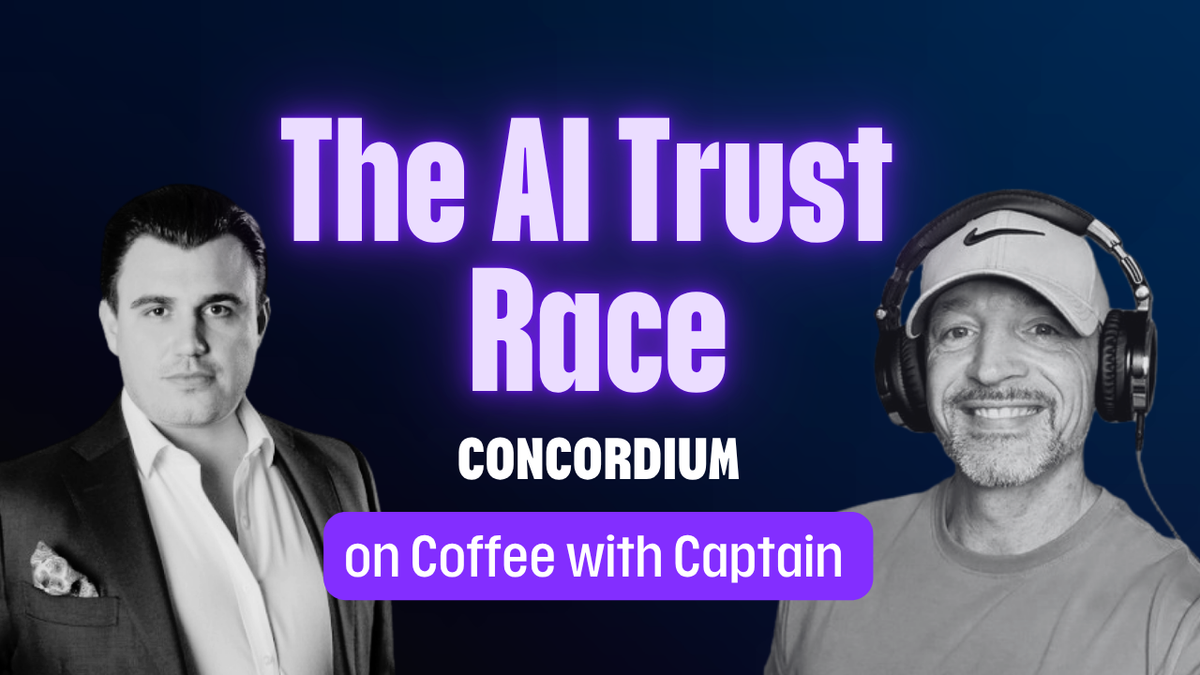
Concordium CEO Boris Bohrer-Bilowitzki featured on Coffee With Captain for an hour on the question hiding underneath the AI agent boom: agents are already transacting, deciding, and acting on our behalf, so who answers when one of them gets it wrong?
Boris makes the case that the industry built agent registries and called the job done, when a registry only tells you what is acting. Knowing who stands behind an agent is a different product entirely, and building that accountability into the protocol itself is where Concordium has spent over five years. The conversation runs from a Friday night pizza order that quietly turns into a regulated transaction, through the EU AI Act and portable identity in Europe, to why enterprise risk officers rather than traders decide when new technology gets adopted.
Along the way Boris shares what is coming next on the roadmap, including identity credentials issued directly to agents, and closes with the three pieces he believes make the difference: identity for humans, businesses, and agents, protocol level tokens, and protocol level locks.
1: Boris's background and the accountability question
- Boris's background: infrastructure builder, ten years in the space
- Nearly a decade in crypto. Before Concordium, founding partner and Chief Commercial Officer of Copper, one of the world's largest custodians and prime infrastructure providers.
- Left Copper specifically to build a different type of infrastructure, landing at Concordium, which he frames as a very unique protocol.
- Captain's framing: trust is the next major infrastructure challenge
- AI agents are already creating content, making decisions, and transacting on behalf of people and businesses.
- Registries exist (Ethereum was early there), but the open question is what happens when something goes wrong.
- The episode's stated scope: how World Network, Google, Visa, MasterCard, regulators, and Concordium each solve different parts of the AI trust problem, with Concordium's angle being accountability for agentic commerce and how Ethereum and Solana developers can access that trust layer without migrating chains.
- The opening question: should accountability have been step one?
- Captain's illustration: you ask an agent to book a $300 flight, it books a $3,000 one. Who is accountable, who do you go back to, how do you reconcile that.
- His challenge to Boris: was it a mistake that trust was skipped as the foundational layer before agents were allowed to transact at scale on behalf of humans and businesses.
2: The core thesis, agents without accountability
- Agents have already overtaken humans in internet activity
- Most people are unaware of this. Agents are past the browsing stage: they transact, decide, and act on our behalf.
- For the first time in history, something is acting that is neither a person nor a corporation. The entire accountability system was built on those two categories, and neither applies.
- This wave breaks the historical pattern
- Every prior technology wave gave society time to build guardrails before it scaled. This one gives no such window.
- The agentic economy is compounding faster than initially anticipated while the infrastructure meant to make it safe is missing.
- Without identity, autonomous action becomes a risk that could kill the agentic economy in its infancy.
- Regulation has moved from fringe to center stage
- When Boris started in crypto, regulation was a distant concern. Now everyone tracks the CLARITY Act, NICA, and more.
- He points to the previous week's events where exchanges had to leave Europe as evidence of how sharp the regulatory environment has become.
- The self-driving car question at internet speed and scale
- When an agent gets it wrong, who answers: the person who built it or the one who deployed it? Where is the line?
- Millions of economic actors are being shipped onto the internet with wallets and decision-making power, most with no accountable human or business standing behind them.
- Boris calls this terrifying, and says anyone paying attention should feel the same.
- Identity was never the hard part. Accountability is.
- Proving an agent exists is different from knowing who stands behind it. That gap is the whole ballgame.
- The agentic economy needs zero additional intelligence (a point Boris published months ago). Every new model ships smarter, faster, better at coding. What no model has ever had is accountability.
- He references the Fable 5 news (restricting the model's availability for the wider world) as a major piece of news for him personally, parked for a separate conversation.
- Registry versus accountability layer: two different products
- Standards like ERC-8004 prove an agent is consistent, meaning the agent you talk to today is the same one from yesterday. That is all they do.
- They cannot tell you who is responsible when the agent misbehaves. An agent registry tells you what is acting; an accountability layer tells you who to hold responsible.
- The industry built the first product and called it done. In Concordium's opinion, it is absolutely not done.
- Alpha note: unannounced deals pending
- Boris again hints at "huge stuff around the corner" in current conversations, with timing held back until the market recovers.
3: Why it can't be retrofitted
- AI trust is becoming an industry-wide priority, with one catch
- Yes, others see the missing step. It has to become a priority.
- The catch: accountability can't be fitted retrospectively. Concordium's homepage message is one protocol for both humans and agents, living on the same infrastructural layer rather than a bolt-on tool applied afterwards.
- The healthcare scenario: where the gap becomes concrete
- Boris's preferred example, and one several businesses are actively pursuing: an AI agent with access to patient records reads them, connects the dots, and recommends a treatment. The patient is harmed.
- The investigation begins. The agent exists, the wallet exists, the transaction history exists. The responsible human or business doesn't. That is the gap.
- Society got comfortable handing over data through twenty-plus years of the application layer internet. Now we're about to hand agents the keys to our money and decisions. Bolting accountability on after the fact won't cut it.
- Five years of contrarian positioning pays off
- Concordium has been in the identity game since the beginning, over five years. Nobody wanted anything to do with them because identity was the opposite of what the entire industry was building.
- The difference: identity and the accountability layer are built into the protocol. Ethereum can't do this, Solana can't, and in Boris's view none of them will be able to.
- As it stands today, Concordium is the only place where verified humans, businesses, and verified AI agents live on the same identity layer, built in from day one rather than stapled together after launch.
- Traceability without exposure
- Zero-knowledge proofs confirm that a real, verified human or business authorized a specific agent without exposing anyone's identity. Accountability requires traceability, never exposure.
- A stolen key can hijack an agent, but it can't steal the identity behind it. That is the difference between securing a key and securing a person, and between an app-layer patch and protocol-level trust.
- The HTTPS moment for agents
- The Verified by Concordium badge is live, with roughly 700 to 1,000 agents already in the registry by Boris's estimate.
- His comparison: HTTPS. It won't stop every mistake, but it guarantees that when something goes wrong, a real human stands behind the agent saying "that's on me, that's my agent."
- Built to work wherever agents already live
- The registry is interoperable with Ethereum, Solana, and Fetch today, with NEAR expected soon.
- Web2 agents are covered too, a fast-growing category. Enterprises deploy agents in the cloud (metadata in the form of an agent card), living in a Web2 world rather than on-chain. Some are consumer-facing.
- The pitch in one line: Concordium adds the accountability layer your agent is missing, wherever it runs.
- Closing reframe leading into the next section: every enterprise adopting agents is an accountable entity by law.
4: Enterprises, the $30 trillion economy, and the Tesla exchange
- The corporate accountability system already exists, agents just sit outside it
- Incorporation documents, directors, signatures: that is what the legal system was built for. Boris is a director in companies himself, and a signature means responsibility.
- The moment an agent negotiates a contract or moves treasury funds, someone has to be able to say "I own that decision." Concordium built the infrastructure that makes that provable, and in Boris's words, nobody else has. The world simply hasn't understood it yet.
- Guardrails as an accelerator, never a brake
- Boris hears the objection constantly: "now I have to do an extra step." His answer is the opposite framing.
- The point of building accountability in is to let agents run at full speed without anyone ending up on a first-class ticket to the Bahamas when they booked a flight to Amsterdam.
- The $30 trillion claim
- The agentic economy is projected to hit around $30 trillion by 2030.
- Boris's one-liner: nobody and nothing scales a thirty trillion economy on anonymous actors. Trust is the infrastructure, and that infrastructure is what Concordium builds.
- Captain's Tesla realization: trust means knowing who to call
- Captain fully trusts his Tesla to drive itself: it thinks faster, processes faster, has no blind spots, and once stopped for a rabbit in the dark before he even registered why.
- His insight, sharpened by Boris ("and if things do go wrong, you know exactly who to call"): the trust rests on knowing Tesla is accountable, with millions of proven miles behind it.
- The counterfactual: an identical car from an unknown startup at half the price, allegedly just as safe, but with nobody identifiable behind it. He would never drive it.
- His transfer of the analogy: agent transactions may rarely be life and death, but financially the market is just as big or bigger. At $30 trillion, an anonymous world simply does not get us there.
5: The pizza and beer example, accountability both ways
- The setup: an agent with access to your money
- Boris runs agents "all over the shop." His scenario: it's Friday, the agent pings him suggesting the usual pizza order (delivered with the insulting tone he prompted it with).
- Add a beer to the order and you're suddenly in a regulated industry: alcohol requires proof of being over eighteen.
- Direction one: protecting the owner's money
- Because the agent has access to his funds, the deployment instruction matters: order from Deliveroo specifically, making sure the money reaches the real merchant rather than an impostor.
- The flaw in today's registries: you can hook up any URL and claim to be Amazon. The URL is what gets verified and registered. That is the extent of it.
- The missing puzzle piece is hooking the agent up to somebody accountable on the back end.
- Direction two: protecting the merchant
- The other side needs its own guarantees: confirm the customer is over eighteen, confirm the delivery address is real and serviceable.
- Boris's abuse example: without this, someone pushes through an order for five thousand pizzas as a Web2-style DDoS attack on the pizzeria. Accountability both ways closes that door.
- What enterprises actually say behind closed doors
- Boris speaks with big enterprises daily, and the consistent line: "I'm not letting this anywhere near external interaction without that accountability layer. I've got a regulator, I've got a share price. Somebody needs to be held accountable."
- The naive workaround, an Excel sheet mapping agent 123 to Pete, fails because the technology's complexity far exceeds analog record-keeping.
- Boris's repeated claim: Concordium is the only one that can solve this right now. His closing call: "Wake up, people."
6: Complementary positioning and the crypto industry verdict
- Complementary, never competitive
- Boris's message to Solidity loyalists: stay there, that is your own decision to make (with his prediction you will eventually realize it may fall short of its reputation).
- To the Ethereums and Solanas: Concordium is no invasive species trying to eradicate anyone. Keep building, shipping, and paying where you are, and use Concordium as the accountability and trust layer, because with regulation tightening everywhere, that piece cannot be built at their level.
- Certain verticals (e-commerce, healthcare, financial services) may justify running the entire payment stack fully or partially on Concordium, but interoperability is the whole idea either way.
- Alpha note: payments stack purpose and pending announcements
- The reason Concordium built last year's stack was to cover the entire payments world.
- Second teaser of the session: huge stuff is brewing, and announcements are being timed deliberately against a weak market. Every interaction rubber-stamps that the play is cross-ecosystem.
- The industry verdict: horrible, abysmal failure to build usable things
- His observation on culture: ten years ago everybody helped each other, now everybody guards their walled garden. Captain agrees interoperability was originally the point of blockchain.
- The tell: everyone concludes they "might need to build my own chain." If Ethereum and Solana were so great, people would just use them for free. They don't, because those chains can't serve an industry at scale in a regulated way.
- Root cause traces back to core setup: anonymity is a completely different thing from privacy. Boris has zero interest in trading with sanctioned actors, and every law works as a gate: comply or you're out.
- The cypherpunk tension, and the blockchain versus crypto distinction
- Deep down, the cypherpunk in Boris wishes the industry could ignore regulation entirely and just build the next economy. The rabbit hole is too deep for that now.
- His key distinction: the technological layer (blockchain) versus the application (crypto). He wants the underlying technology implemented, which is what Concordium has done, having stepped away from meme coin territory.
- His signature phrase: the blockchain is there to be used, never to be understood. Nobody questions the payment flow when buying coffee at Starbucks. Nobody asks who the PSP is or who pays what along the value chain. Beep, coffee, done.
- Why the big ecosystems sit 85 to 90 percent below their highs
- Boris doubts they return to those levels, because different forces are now at play. That demands a different kind of blockchain to take things to the next realm.
- Credit where due: NFTs, DeFi, and tokenization were cool ideas from real innovators. His Copper-era anecdote: someone wanted to tokenize a Picasso, and his response was that an asset without liquidity in traditional form gains no magic liquidity when tokenized. Wrong thinking, right instinct to ask what needs building.
- In terms of tooling, his verdict is that the industry is completely broken, and Concordium is built different.
- The DYOR reframe: everyone has an analyst team now
- To those still nursing 99.9 percent losses on 2021-era CryptoPunks and Apes: ask the right question. AI gives everyone a research analyst team in the palm of their hand.
- The right questions: who is building real stuff, unlike the 2018-2019 cohorts still ruling CoinMarketCap? Who is building something useful down the line?
- The forward vision: today you code agents up via OpenFloor, Hermes, or Strawberry. Coming businesses will let you assemble agents from prompts like Lego (echoing DeFi's money Lego), with a verifiable accountability and trust layer powered by Concordium included by default.
7: Merit-based selection and the agent IDP roadmap
- Captain's scaling question, with the registry live on screen
- He pulls up Concordium's agent registry showing 664 registered agents, and asks: when this goes from 664 to 6 million, how do businesses decide which agents to trust? Brand reputation? Keyword search in the dashboard?
- Boris's answer: you don't search it. The registry is back-end infrastructure, and that is the major difference people haven't understood yet.
- Registry composition confirmed on air: Concordium-native agents plus roughly 240 external ones, including Fetch and Solana agents.
- Agents choose on merit, humans choose on marketing
- The human decision process: you buy a Tesla over an unknown startup's better-looking car because Musk is everywhere, under global scrutiny, with trillions behind him. Trust flows from visibility.
- The crypto equivalent: protocols get chosen by who headline-sponsors Consensus in Tokyo or ranks highest on CoinMarketCap and CoinGecko.
- An agent works differently. It exists solely to serve an overarching purpose written down by its owner: fastest from A to B, cheapest from A to B, irrespective of who spends the most on marketing.
- The consequence: by default, the agentic economy chooses based on merit. Counterparty verification happens invisibly, like his coffee example, where the buyer never worries about whether the right counterparty is on the other side.
- Roadmap alpha: the agent identity provider (agent IDP)
- Today's registry links an agent to a human. The next step, visible on Concordium's roadmap, is the agent IDP.
- Currently only human and business identity providers exist (think VO, Fedos, and similar businesses). The agent IDP extends verifiable credentials to agents themselves.
- Back to the pizza and beer example: the agent must prove it acts on behalf of somebody over eighteen. Issuing those credentials to an agent sounds easy, and in Boris's telling it only is on Concordium.
- The reason: if identity sits at the application layer, a stolen key becomes an identity problem. When everything sits on the same protocol layer, the problem disappears.
- Zero-knowledge proofs in practice: yes/no instead of documents
- The over-eighteen check runs as a pure ZK query: are you over eighteen, yes or no. No birthday, no passport copy, no driver's license, no height, no exact birth date.
- The familiar failure mode: you hand over full documents, six months later the database is hacked, seventy million national insurance numbers leak, the company pays a twenty million dollar fine, and that is the end of it. GDPR exists because of this pattern, and it still goes wrong.
- The Concordium model: complete KYC once, then interact in a privacy-preserving way within the ecosystem forever after.
- His stadium image: walking into a football ground to buy a beer, nobody should need to see his passport and national insurance number held up for all to view. Proving over-eighteen is the entire requirement.
8: The EU AI Act and portable identity
- Captain's question: is identifying an AI system enough?
- Sitting in the US, he is tangentially familiar with EU AI Act Article 50, which introduces transparency obligations for AI-generated content in certain contexts, with deployment beginning in August.
- His guess: mere identification falls short, and this regulation plays straight into what Concordium is building. Boris confirms: one hundred percent.
- Boris's TLDR of the EU AI Act
- The Act sorts AI systems (models, agentic workflows, anything) into risk tiers.
- Banned: social scoring, market manipulation, and similar. High risk: law enforcement contexts and the like, carrying heavy compliance requirements. He gives the example of a chat agent interacting on behalf of a bank like HSBC: what can it say, who can it interact with, what disclosure applies, how is data handled. Minimal risk: no extra rules, such as using a model for research.
- Coverage extends to general-purpose AI models (any LLM), applying the rule sets to any company selling AI or AI-based content or services in the EU.
- Enforcement currently targets the big players (Anthropic, OpenAI and peers), with fines Boris recalls loosely as perhaps five percent of global revenue. He hedges repeatedly on the specifics.
- The deeper point: compliance exists with or without the Act
- The Act itself is beside the point of Concordium's existence. Any business in a regulated area must adhere to compliance rules one way or another.
- His bank illustration: nobody opens an account on a nice face. You will show them everything down to "the blood group of my deceased grandmother."
- Portable identity: eIDAS, EUID, and the QR code future
- Concordium is actively building within Europe's eIDAS and EUID frameworks toward portable identity.
- The target world: scan a QR code at Barclays and your account opens in a split second, because HSBC already verified you.
- His own confession: he stays with HSBC (no fan) purely because switching banks is such a pain. The next layer up: prompting his agent with "mate, sort this out for me, please."
- The NHS anecdote: four and a half months for medical records
- Wanting to increase life coverage for his wife and children, he requested his medical records from the NHS. Delivery took four and a half months while the insurance broker kept chasing him.
- Captain's parallel pain: visiting the same doctor twice and still filling out seventeen check-in forms.
- Dimitri's "new fabric" framing
- Boris quotes his Copper co-founder Dimitri: this technology layer, never mind the ice sprinkled on top, provides a completely new fabric from which entirely new products can be woven, products impossible on the antiquated infrastructure everything currently runs on.
- He adds the caveat that the industry hasn't arrived there yet, and reiterates his preference for abstracting away from pure crypto to the underlying technology.
- Captain's takeaway: medical records may never be the sexy hundred-million-dollar runner, but the pain is universal, and reaching a thirty trillion dollar industry requires impact far beyond the crypto bubble.
9: The enterprise incentive shift
- Why enterprises never adopted blockchain: no real motivation
- The old question "why doesn't Bank of America adopt this?" had a simple answer: nobody brought a solution that let the CEO cut sixty percent of the company.
- In Boris's Copper days, everything was geared toward trading faster, data centers sitting next to the NYSE. Asking "why aren't you using this for everything?" got the same reply: nobody gave us the tools.
- AI changes the equation
- AI's scalability lets enterprises change workflows that have been the norm for decades, and those new workflows require by default a different underlying technology to run on.
- Perspective on the previous era: walking around flogging Bitcoin or getting an ETF out was Mickey Mouse compared to what is now at stake.
- The wrong question and the right one
- "Is AI the saving grace for crypto?" is the wrong question. AI alone won't drive stablecoin volumes through the roof just because an agent has no face and no bank account; Revolut, other neobanks, and eventually the Wall Street whales will solve that part.
- The right question: is AI the catalyst that makes enterprises rethink the infrastructure they operate on.
- The mechanism: a CEO can now stand in front of shareholders and say "if I use this, I reduce our cost base, shareholder value goes up." That produces the decision.
- The boardroom blocker: "you won't get fired for hiring IBM"
- The historical pattern: decisions rest with risk-averse boardroom figures a few years from retirement who keep contracting IBM and wash their hands clean. CYA behavior with zero incentive to change, no matter how long customers spend on paperwork.
- Boris saw this personally in Canary Wharf and New York boardrooms: front-office traders like racehorses in the gates begging to be let off the leash, while the chief risk and chief compliance officers ask "where's the risk, what happens if this happens" and decide against. That is where innovation goes to die.
- The accountability layer answers exactly the questions those officers ask, converting the blockers into approvers.
- The Bezos thought experiment: programmable money as the pitch
- Walk up to Jeff Bezos and ask how many people work in his finance department, then explain programmable money: the entire supply chain programmed into the stablecoin.
- Every time a package is scanned at handover between drivers, a preset percentage instantly appears in that driver's wallet.
- The consequence: five thousand finance people sending money from A to B and processing refunds are no longer needed. Shareholder value goes up, customers likely spend more, a completely new way of doing marketing opens. One example of what was missing: the incentive.
- Captain's synthesis and the four questions
- AI disrupts far more than tech: customer journeys, flows, how we interact in life, and shareholders finally have a bottom-line incentive to switch.
- But as agents act autonomously, handle real value, and touch KYC-type data, every organization must answer four things: who deployed this agent, who authorized it, who is accountable if something goes wrong, and can that be verified without compromising privacy.
- Boris's claim, again: as it stands, Concordium is the only one that can do that. People simply don't know it, because nobody wants to talk about KYC, himself included. Yet nothing works without it. He notes he spoke with some of the biggest businesses on the planet in the last couple of weeks.
10: Regulators, Worldcoin, and closing
- Regulators as beneficiaries, from Boris's direct experience
- Regulation gets tighter, never looser. But once you can prove capability, a regulator only needs to learn how to read a node.
- Boris has spent time with the FCA, SEC, BaFin, MAS, and FMR, and their reaction: "This is a saving grace. Why are you guys so against it?"
- His example: suspicious activity reports (he says "SaaS reports," clearly meaning SARs). Roughly fifteen thousand get filed per day at the FCA alone, and nobody ever looks at them. The alternative: real-time analytics on what happens in the market, gated by knowing who is in it. Entrance identity, agent auditability, and the simple peace of mind that the counterparty is a legitimate actor.
- The Worldcoin comparison
- Worldcoin does cool things on personhood: iris scans, great. But the enterprise part is what ultimately gets pushed, and an individual scanning an iris solves nothing for Amazon wanting to implement accountability at scale.
- It is a different layer, and that layer is Concordium. Boris's claim: the only infrastructure in the world that can provide this today.
- DYOR reprise and the lazy-people jab
- Everyone now has a research analyst team in the palm of their hand. "Do your own research" used to mean listening to your neighbor; now the question can actually be asked. But people are lazy and skip the extra digging. "Sorry to piss a couple of people off."
- The Bitcoin adoption parallel and the passport question
- We are at the same point Bitcoin adoption was years ago: the barrier was never performance or volatility (manageable) but incentive and regulatory framework.
- His philosophical close on identity: why do you have a passport? Your identity is you, yet you carry a little booklet somebody stamps. Digital passports show movement, but every interaction rests on proving you can access a service.
- The cigarette machine anecdote: machines requiring a bank card as an age proxy, because under-eighteens can't hold one. His admission: guilty of borrowing daddy's card. The point: even workarounds need solving, which is why the regulation is so tight.
- Only from the outset, and a jab at the founder class
- Simplifying everything onto one protocol and adding the agentic piece on top is a build you can only do from the outset.
- No harm wished on Anatoly, Vitalik, or Charles ("losing his marbles constantly from one side to the other, but incredibly smart"). The question: will those be the chains that make the world adopt? With agents doing billions of things daily, KYC, AML, and identity cannot be disregarded.
- His formulation: "Like Concordium or Concordium. I'm still yet to see one that has built something like us. Live in production, ready to use."
- Captain's regulatory inevitability close
- AI regulation is coming globally; regions without it today are on borrowed time. His advice to agentic builders: get ahead of it, get the Concordium badge, register the agent today.
- Boris's closing: the three core USPs
- Verify an agent is who it says it is, and when equipped with money, abstract away risks like smart contracts acting as facades.
- The three puzzle pieces: identity for humans, businesses, and agents; PLTs (protocol level tokens, L1 issuance rather than ERC issuance); and protocol level locks, effectively on-chain escrow solving for longer-duration transactions where time value of money matters.
- Builders waking up is a matter of time, and AI is the catalyst: this is the question in conversations with "the big boys," not yet in the media.
- Final alpha teaser
- "Keep your eyes peeled because there is some big shit around the corner," tied explicitly to real-world adoption. Third teaser of the session.
- Captain also name-drops the Danish hockey team partnership as a viable business in customer loyalty on its own.