The Gate Comes First
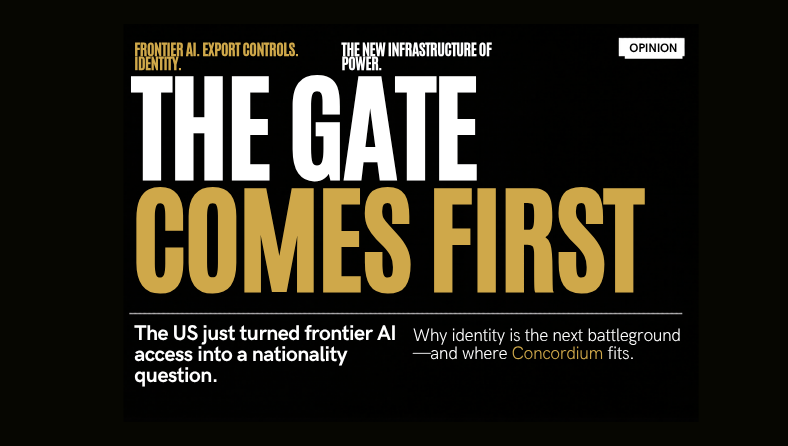
On June 12, the US government turned frontier AI access into a nationality question.
Anthropic says a directive suspended access to Fable 5 (Mythos) for any foreign national, anywhere on earth, including its own foreign-national employees. The order was aimed at a category of people. Yet access went dark for every customer.
Sit with that. The rule now requires the infrastructure to distinguish Americans from foreign nationals, safely, instantly and globally. But the identity infrastructure needed to enforce that distinction is not part of today's frontier AI stack. So the only compliant move is the blunt one: close the door to everyone.
We have seen this film before.
Britain banned the export of its textile machinery to preserve an industrial lead. The Cold War drew an iron curtain around advanced computing. Today it is chip controls against China. Tomorrow it may be intelligence itself. Each time, the dominant power decides a technology is too powerful to flow freely, and begins gating it by nationality, jurisdiction and strategic allegiance.
AI is now the next entry on that list. If history is any guide, this is the first frame of a much longer sequence. More controls. More governments. More frontier intelligence deemed too sensitive to flow freely. More access gated by citizenship, residency, sanctions status, age, license, jurisdiction and purpose of use.
Every export control eventually becomes an identity problem. A government that wants to gate a model has to know who is on the other side of the screen. A provider forced to comply has to prove it. Continuously. Across borders. Across APIs. And soon across the autonomous agents that will browse, spend and transact for us at machine speed, while a human remains accountable somewhere behind them.
The collision comes when those requirements meet today's tools. The crude answer is mass identity collection. Passports uploaded to AI companies. Government IDs stored in corporate databases. Compliance teams sitting on mountains of toxic personal data, one breach away from catastrophe. A surveillance machine assembled in panic to satisfy a legal rule.
We have seen this film before too.
Banking made access to money conditional on identity. As intelligence becomes the new gold, access to intelligence will follow suit. The more valuable, strategic and regulated intelligence becomes, the more pressure there will be to know who is accessing it.
The problem is that we cannot build the gate to intelligence the same way we built the gate to money. Passport scans. Corporate databases. Millions of sensitive documents concentrated in private hands. Unlike a bank account, frontier AI derives its power from information. It learns from it. Infers from it. Connects it. The organizations controlling intelligence may one day possess deeper insights into our lives than any financial institution ever did.
Intelligence may be the new gold, but the infrastructure around it does not need to become the next surveillance machine.
That is why the next AI stack needs a native identity layer. Verifiable, programmable and private by default. A way for a person to prove only what the gate requires: I am eligible. I am human. I am in the right jurisdiction. I am outside the sanctioned list. This agent is authorized by me. This use is permitted. All proven without surrendering the document, without exposing the person, without turning the provider into a honeypot.
This is where Concordium's design begins to look prescient.
It provides exactly what gated AI now demands: a way to satisfy the regulator without building a surveillance machine. The gate can verify citizenship, residency, age, sanctions status or authorization. The individual proves what matters and reveals nothing else. The provider receives compliance without collecting passports. The government receives accountability without creating a database.
Underneath, that is achieved through privacy-preserving, self-sovereign identity and zero-knowledge cryptography. The service receives proof, not papers.
The final piece becomes visible as AI agents arrive. Every autonomous agent needs an accountable human behind it. Someone who authorized it. Someone who remains responsible for its actions. Concordium binds that accountability to the agent without sacrificing privacy.
Concordium allows an agent to prove that a real person stands behind it, while the counterparty proves it is real in return. Two machines transacting. Each accountable. Neither surveilled.
The Anthropic Fable 5 debacle shows how Concordium sits at an intersection the market has not yet priced: AI, export control, digital identity, compliance, privacy and agent authorization running on regulated rails.
Most projects touch one edge. Concordium was engineered for the collision itself.
The old internet asked one question: can you connect?
The new internet asks a harder one: can you prove you are allowed?
For AI, the gate now comes first.
Concordium forged the key before the door appeared.