Open Floor: On Agent Payments and the Rails Question
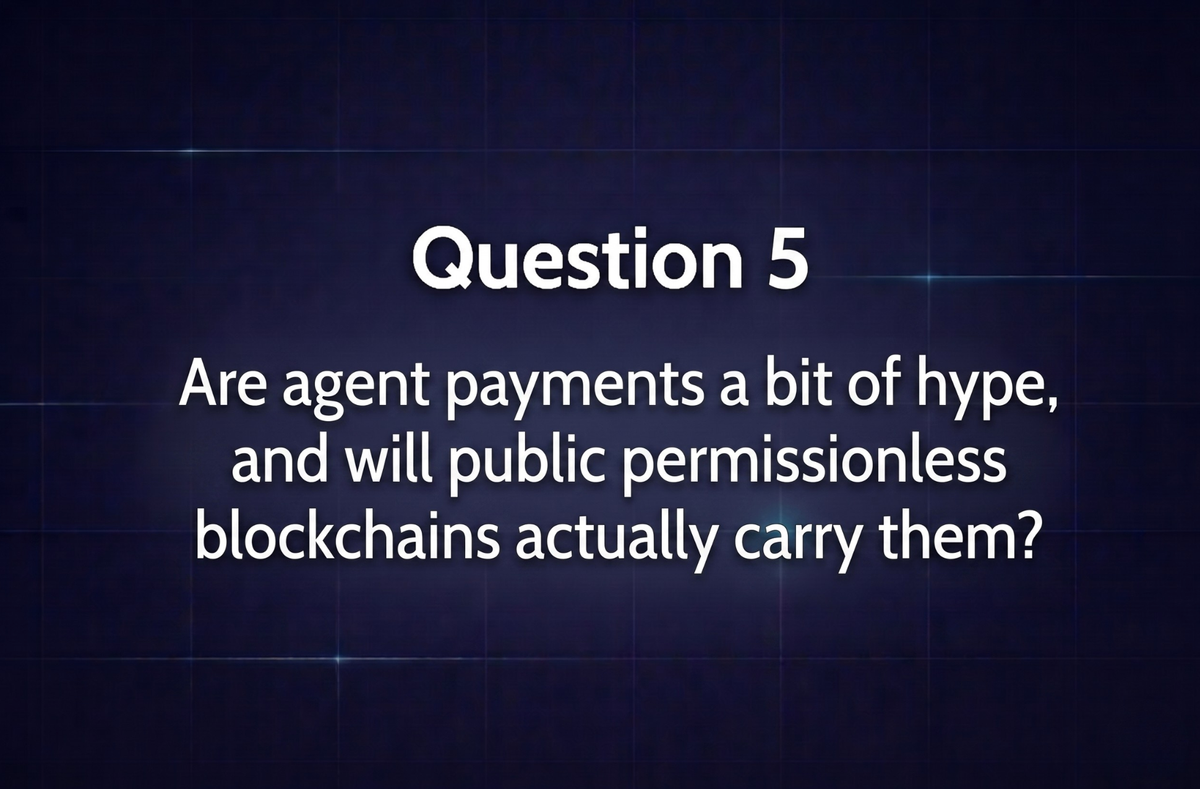
A reader asked the Open Floor Initiative whether agent payments are a bit of hype at the moment, whether too many hopes are being placed in that basket, and whether public permissionless blockchains will actually be used to carry them. The reader's own intuition was that it could take years before agent payments really take off, and that even then, traditional rails might end up doing most of the work.
The question raises two separate doubts: a timeline doubt, and a rails doubt. Both are well-founded as the data currently stands, and each deserves its own answer.
The timeline doubt is supported by the data, including the most bullish forecasts
It's correct that the visible activity is overstated. Artemis Analytics found that approximately 48% of x402 transactions and 81% of x402 transaction volume were linked to wash trading as of December 2025.
This pattern is not isolated to agentic payments. Even stablecoins, which are otherwise growing rapidly and have reached around $33 trillion in annual transfer volume, suffer from similar measurement distortion. A separate Visa and Allium Labs study found that less than 10% of stablecoin transaction volume is organic, with the rest attributable to bots, arbitrage, liquidity provision, and automated market making.
Some of this is simply the nature of crawling before walking. Early-stage infrastructure has thin organic volume by definition, and the measurement infrastructure itself is still being built. What matters is that the institutions producing the bullish forecasts are doing so with full awareness of this present state, which is precisely what makes the projected ramp credible rather than fanciful.
| Source | Current state | Projected | Year |
|---|---|---|---|
| Juniper Research (April 2026) | $8B total transaction value | $1.5T | 2026 → 2030 |
| McKinsey (October 2025) | "Phase of rapid experimentation" | $3T–$5T globally | 2030 |
| Edgar Dunn & Co. | — | $1.7T AI-driven commerce | 2030 |
Juniper's own framing is that current deployments are pilots, with the gap between today's $8 billion and the 2030 projection coming from infrastructure maturation, regulatory clarity, and trust development. ACI Worldwide, the bill-payment processor that runs SpeedPay for major U.S. utilities and processes tax payments for the IRS, has argued in Forbes that a meaningful share of what is marketed as agentic commerce is in fact rebranded recurring-payment infrastructure that has existed for over a decade.
So an intuition that this plays out over a multi-year horizon rather than in the immediate term is the correct read of the present moment. But there is a separate observation that complicates the picture, which is that markets do not wait for destinations to arrive before they begin pricing them.
When a structural thesis becomes credible — when the enablers fall into place and the trajectory becomes legible — re-pricing typically begins long before the destination is reached. Uber, founded in 2009, was worth between $150 and $200 billion well before it posted its first annual profit in 2023. The market was not pricing the profit. It was pricing the credibility of the path.
This is the central argument of a longer essay published independently on May 1, The Path Becomes Credible Before the Destination Arrives, which was not written in response to the present question but covers much of the same territory.
The institutional commitments in the past twelve months suggest the structural setup is in place
The list of infrastructure milestones in the past year is substantial. Mastercard completed its first live agentic payment transaction on 29 September 2025, and by mid-November had enabled all U.S. cardholders for Agent Pay. Google launched its Agent Payments Protocol (AP2) on 16 September 2025, backed by Mastercard, PayPal, American Express, Adobe, and Alibaba.
Stripe and Paradigm launched the Tempo mainnet in March 2026 alongside the open-source Machine Payments Protocol, with Mastercard, UBS, and Klarna as backers. Visa unveiled Intelligent Commerce Connect in April 2026 as a protocol-agnostic merchant on-ramp supporting Trusted Agent Protocol, Machine Payments Protocol, Agentic Commerce Protocol, and Universal Commerce Protocol from a single integration point.
In October 2025, India's National Payments Corporation, Razorpay, and OpenAI launched a live pilot enabling UPI payments via ChatGPT, the first agentic commerce deployment at national scale. The Coinbase and Cloudflare x402 Foundation, supported by Circle, AWS, Stripe, and Google, is building stablecoin-based agent payments into the HTTP layer of the web.
The question, in other words, is no longer whether agent payments are real. It is which rails carry them.
The rails question is genuinely undecided, and the framing matters more than the bull/bear scoreboard
The honest answer depends on which problem one treats as the real one to solve. Most discussions frame it as a commercial question — whose rail captures the margin — but the deeper problem is accountability. This is the question taken up at length in Two Stacks, One Problem, and the framing matters here.
Two architectures are emerging from opposite ends of the stack. The TradFi approach extends existing card and account-to-account rails with new agentic standards (Google's AP2, OpenAI and Stripe's Agentic Commerce Protocol, Mastercard's Agent Pay, Visa's Trusted Agent Protocol). Accountability is handled reactively: the agent acts, the system records, humans review when something goes wrong. Mastercard's Verifiable Intent framework is the cleanest expression of this design.
The crypto-native approach takes the opposite direction. Instead of watching the agent and adjudicating after the fact, it encodes constraints into the infrastructure itself so that the unintended action becomes mechanically implausible. Coinbase's Agentic Wallets, launched recently, give AI agents non-custodial wallets with programmable transaction limits, while the x402 protocol enables machine-to-machine micropayments over HTTP without traditional rails.
The differences map cleanly across every critical dimension.
| Dimension | TradFi Stack | Crypto-Native Stack |
|---|---|---|
| Philosophy | Common Law: reactive, precedent-based | Napoleonic Code: prescriptive, encoded by design |
| Identity | Bank KYC extended with agent tokens | Wallets, emerging on-chain Know Your Agent |
| Delegation | Verifiable Intent logs, spend limits via PSPs | Programmable permissions encoded on-chain |
| Settlement | Batch processing, settlement windows | On-chain, near-instant, always on |
| Core weakness | Built for humans; accountability retrofitted | Built for trustlessness; real-world identity missing |
What is striking on inspection is that the weaknesses are complementary. TradFi lacks programmable settlement, encoded delegation, and open standards, all of which crypto has natively. Crypto lacks real-world identity, regulatory integration, and institutional accountability chains, all of which TradFi provides through banking relationships and decades of accumulated trust infrastructure.
Neither stack is sufficient alone, which is what makes some form of convergence inevitable. The rails that win will be the ones that resolve it, combining programmable settlement with verifiable identity, encoded delegation with open standards.
Public permissionless blockchains have a structural advantage on programmable settlement and encoded delegation, and a structural deficit on real-world identity. The chains positioned to carry the full convergence are the ones that close the identity gap natively, and Concordium is the cleanest expression of that design — protocol-level identity and zero-knowledge attestations of age, residency, or jurisdiction baked into every wallet account, with the December 2025 integration into the x402 standard already showing what the convergence looks like in practice.
Stepping back, the picture is more upbeat than the skepticism suggests. The convergence of stablecoins solving the unit-of-account problem with the arrival of autonomous agents as the user that on-chain rails were always architecturally suited for is the moment public blockchains have been waiting for. It is, in a real sense, the use case the technology was built for, finally meeting its user.
For chains positioned to carry the convergence rather than just one half of it, the optionality on offer is generational. The skepticism in the question is warranted on present data. But the structural opportunity is so large, and the architectural fit so direct, that there is no excuse for any blockchain that can carry it not to pursue it with full conviction.
The deeper case for why this cycle compresses faster than the last two
This Q&A answer addresses what is true about the present skepticism. The longer essay published on 1 May, The Path Becomes Credible Before the Destination Arrives, addresses why the trajectory is becoming credible despite the skepticism being well-founded — specifically, why stablecoins solving the unit-of-account problem and the arrival of agents as the user the rails were built for together constitute the structural equivalent of an iPhone moment for permissionless payment infrastructure.